
AI Makes You Ship Faster — But Are You Shipping the Right Thing?
AI has compressed development cycles from months to days. But speed without direction is just organized chaos. Here's why customer feedback is the missing piece that separates AI-powered winners from teams building the wrong thing at record speed.
Priya Sharma
Head of Product Engineering

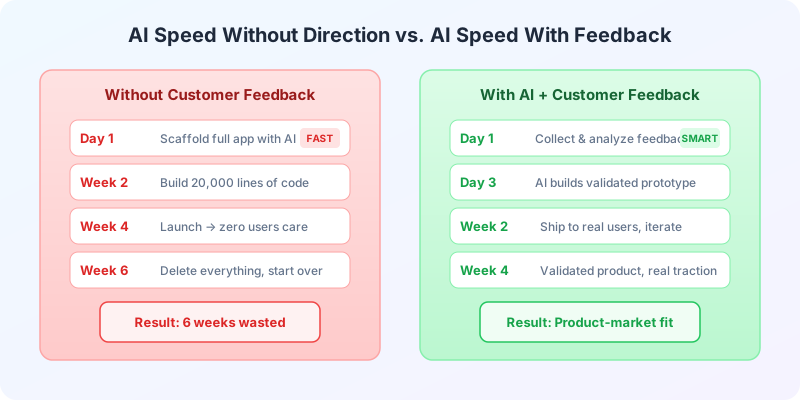
A developer recently built 20,000 lines of working code in two weeks using AI. A custom newsletter platform, fully functional, test-covered. Then he deleted every line of it.
The problem wasn't the code. The code was excellent. The problem was that he'd solved the wrong problem entirely. As Joe Masilotti wrote in his widely-shared post: "AI makes it easier to build the wrong thing faster."
This is the defining paradox of software development in 2026: AI has made execution nearly free, but deciding what to execute has never been more expensive.
The Speed Revolution Is Real
The numbers are staggering. Guillermo Rauch, CEO of Vercel, recently built a production-ready app in under two hours for $20 — work that would have taken weeks and thousands of dollars just a year ago. Vercel's v0 platform now generates 6.4 apps per second. Deepinder Goyal, CEO of Zomato, reflected that what took 18 years to build could now be done in 7–8 years with AI assistance.
The research backs this up. McKinsey's 2025 study on AI-driven software organizations found top performers achieving:
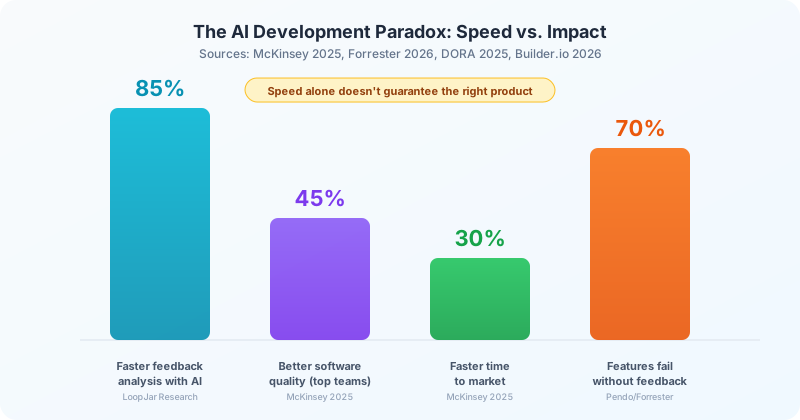
- 16–30% improvements in team productivity and time to market
- 31–45% improvements in software quality
- 85% reduction in feedback analysis time (from weeks to hours)
Forrester predicts that software development will become AI's #1 use case in 2026, with "vibe coding" evolving into full "vibe engineering" — delivering production-grade outputs, not just code snippets.
Sam Altman himself signaled this shift, revealing that OpenAI is now prioritizing speed over cost: "There's another dimension we haven't thought about as much historically… the speed we can deliver it at. Delivering outputs in 1/100th of the time."
The Dangerous Illusion of Velocity
Here's what nobody tweets about: 70% of features built without customer feedback fail to deliver value. That stat, from Pendo and Forrester research, was alarming when development took months. Now that AI can ship features in days, the failure rate doesn't change — it just compounds faster.
Eric Wilson captured this perfectly in his February 2026 essay: "When everyone can build, who decides what to build?" The bottleneck has fundamentally shifted.
"The friction of slow development used to be a forcing function for thinking. Now AI removes that friction — and teams travel at full speed with no idea where they're headed."
Builder.io's analysis confirmed this: while AI has made code generation nearly free, the real delays now come from planning, design reviews, coordination, and wait times between team members — not coding itself. Companies succeeding with AI changed their entire systems, not just added tools.
The $2 Million Lesson
One of the most compelling case studies from early 2026 came from a CPO who resisted the urge to "vibe code" three separate MVPs. Instead, he used AI strategically — not to build, but to listen:
- Sent personalized AI-drafted emails to their top 200 customers
- Received 150 detailed feature requests within a week
- Used AI to cluster and prioritize the requests by revenue impact
- Identified 3 common asks that 80% of customers shared
- Built and shipped those 3 features in two weeks
The result? $2 million in new annual revenue — without writing a single line of throwaway code.
The lesson is clear: AI's greatest power isn't writing code. It's compressing the feedback loop between "what do customers need?" and "here's what we built."
What the Smartest Teams Are Doing Differently
The DORA 2025 Report found that AI's primary role is amplifying an organization's existing strengths and weaknesses. Teams with strong feedback loops get stronger. Teams without them get worse, faster.
Here's what the winning pattern looks like:
1. Feedback-First, Code-Second
Instead of building features and then asking users what they think, top teams collect and analyze feedback before writing a single line of code. AI makes this practical at scale — tools like LoopJar can process thousands of feedback items in minutes, surfacing patterns no human could spot manually.
2. Tighter Iteration Cycles
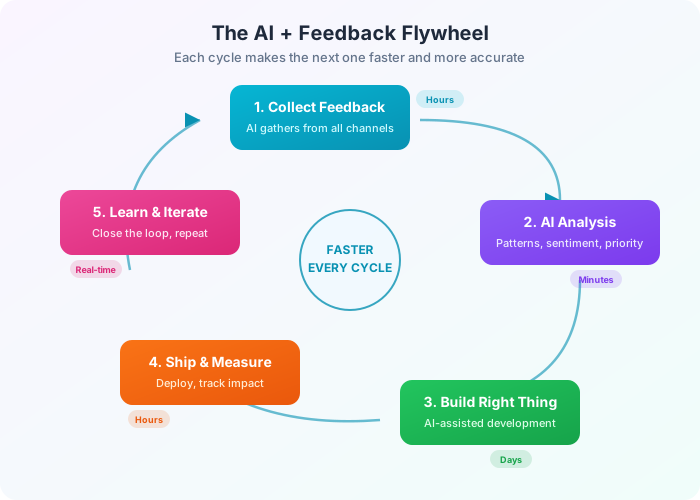
The old cycle was: Plan (weeks) → Build (months) → Ship → Wait for complaints. The new cycle is: Collect feedback (hours) → AI analysis (minutes) → Build prototype (days) → Ship → Measure → Repeat.
Guillermo Rauch calls this a "prototype culture" — replacing written documentation with working demos that generate higher-quality feedback than any spec ever could.
3. AI as Analyst, Not Just Builder
One engineering manager's experiment revealed a striking insight: with AI handling the heavy lifting, 98.3% of development effort went to sustainable practices — tests, documentation, refactoring, and infrastructure. Only 22.7% of commits were new features. AI didn't just make them faster; it made them better.
4. Real-Time Signal Detection
SaaStr's experience managing 30 production AI agents taught them that daily human feedback and review is non-negotiable. The same applies to product development: real-time feedback monitoring catches churn signals, identifies urgent bugs, and surfaces emerging needs before they become crises.
The Flywheel Effect
When you combine AI-powered development with continuous customer feedback, something remarkable happens: each cycle makes the next one faster and more accurate.
- Cycle 1: Collect feedback → AI identifies top 3 pain points → Build and ship in 2 weeks → Measure impact
- Cycle 2: New feedback flows in → AI spots patterns instantly → Ship improvements in 1 week → Higher customer satisfaction
- Cycle 3: AI predicts emerging needs before users report them → Ship proactively → Users feel heard
This is the flywheel that separates companies growing at 2x from those growing at 10x. Speed alone gets you 2x. Speed plus direction gets you 10x.
The Feedback Gap Is the New Technical Debt
Forrester's 2026 predictions note something concerning: while AI adoption is high for coding (48%) and testing (47%), it lags dramatically for finding development insights (33%). Most teams are using AI to build faster but not to build smarter.
This "feedback gap" is the new technical debt. Every feature you ship without validated customer input is a bet — and AI just made those bets cheaper to place but no less risky to lose.
McKinsey's research confirms this: only a select subset of companies is reaping particularly large gains from AI, and the differentiator isn't better tools — it's complete overhaul of processes, roles, and ways of working to integrate feedback at every stage.
How to Start: The 48-Hour Test
Before your next sprint planning, try this:
- Hour 1–2: Feed all your customer feedback (support tickets, NPS comments, reviews, social mentions) into an AI-powered analysis tool
- Hour 3: Review the AI-generated clusters. What are the top 5 themes? What's the sentiment trend?
- Hour 4–8: Cross-reference with your current roadmap. How many planned features address the top themes? How many don't?
- Day 2: Reprioritize based on evidence, not intuition. Ship the highest-impact item first using AI-assisted development
Teams that run this exercise consistently report shipping features that customers actually want — and eliminating up to 40% of planned work that wouldn't have moved the needle.
The Bottom Line
AI has given every team a Ferrari. But a Ferrari without a map just means you get lost faster.
The teams winning in 2026 aren't the ones coding fastest. They're the ones who know exactly what to code — because they built a feedback loop that's just as fast as their development cycle.
Speed is table stakes. Direction is the competitive edge. And the gap between the two? That's where tools like LoopJar live — turning raw customer signal into the exact roadmap your team needs, in minutes instead of months.
Stop building faster. Start building right.