
The Twitter Trap: Why Listening to Your Loudest Users is Killing Your Product (And How AI Fixes It)
Product Managers on Twitter are exhausted by 'feature request fatigue' and the 'feedback black hole.' Learn why the loudest user isn't always right, and how LoopJar uses AI to surface the quiet, high-value signals.
Marcus Rodriguez
Growth Product Manager
Spend five minutes on "Tech Twitter" (or X) and you will see a familiar pattern. A user tags a SaaS founder: "Hey, when are you going to build a dark mode? It's literally a 5-minute CSS fix. I'm cancelling my subscription."
The founder, eager to please, replies: "We hear you! Pushing an update this weekend."
This looks like great customer service. But behind the scenes, it's a nightmare for Product Managers. It's called the Twitter Trap.
The Pain Points of Modern Feedback Monitoring
We've been monitoring the discourse among Product Managers online, and the pain points are clear, consistent, and loud.
- Recency Bias (The Loudest User Wins): The person screaming on social media gets prioritized over the quiet enterprise client who submitted a thoughtful support ticket six months ago.
- Tool Sprawl: Feedback arrives via Slack, Discord, Zendesk, Intercom, email, and Twitter DMs. PMs spend more time hunting down feedback than analyzing it.
- The "Black Hole" Effect: Users submit feature requests via forms, but because teams are overwhelmed by noise, the requests sit in a Jira backlog forever. Users feel ignored.
- Feature Request Fatigue: Users don't know what they want; they know what they think will solve their problem. ("Add a giant red button" vs. "I can't find the checkout").
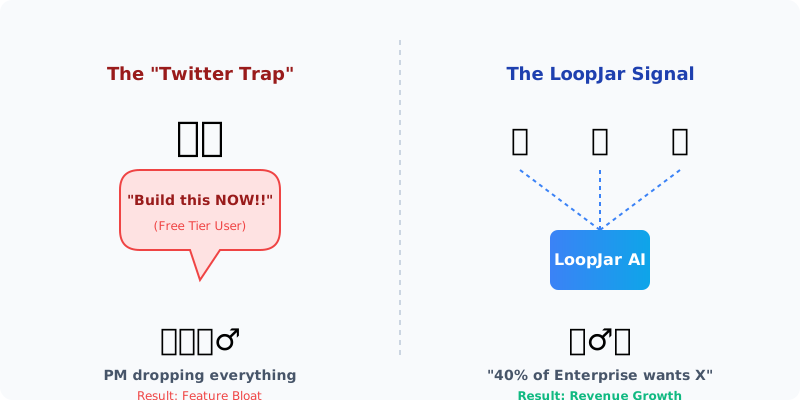
Why the Loudest User is Dangerous
When you react to the loudest voice in the room, you are often building for your least valuable cohort.
The user complaining on Twitter might be on a free trial. Meanwhile, thirty Enterprise customers might be struggling with a complex integration issue. But because they submitted their feedback quietly via Zendesk, it got buried under a mountain of "Dark Mode" requests.
When you prioritize noise over signal, you get Feature Bloat. You build a Frankenstein product trying to please everyone, but you solve the core problem for no one.
How LoopJar Breaks the Twitter Trap
To fix this, you have to separate the volume of the complaint from the value of the user. You need an AI that doesn't panic.
This is exactly why we built LoopJar.
1. Universal Ingestion (Kill the Tool Sprawl)
LoopJar connects to Intercom, Zendesk, Slack, and your public feedback board. It pulls every piece of feedback into a single, unified stream. No more tab-switching.
2. The "Quiet Majority" AI Engine
Instead of sorting by "Most Recent" or "Most Upvotes," LoopJar's AI analyzes feedback by Customer Value (ARR) and Sentiment Velocity. If 40% of your Enterprise tier is quietly asking for SSO integration, LoopJar flags it as "Critical Revenue Risk"—even if the Twitter crowd is silent about it.
3. Translating "Features" into "Pain"
When a user asks for a "giant red button," LoopJar's semantic parsing doesn't just tag it as `UI Update`. It extracts the underlying intent: `Checkout Friction`. It groups it with all the other tickets where users struggled to pay.
Conclusion: Build for Value, Not Volume
The next time you get a loud feature request on Twitter, don't drop your sprint plan. Acknowledge it, log it, and let the AI do its job.
Stop chasing the noise. Start building what actually moves the needle. Let LoopJar show you the difference.