
Claude Just Found 10 Firefox Bugs — Why AI Code Review Is Now a Product Safety Feature
Anthropic's Claude discovered 10 real security vulnerabilities in Firefox's codebase. This isn't a party trick — it's the moment AI code review graduates from dev perk to product-critical infrastructure.
Alex Rivera
Security & AI Research Lead

In early March 2026, Anthropic quietly did something that should have made headlines across every product, engineering, and security team in the world: they pointed Claude at Firefox's codebase and let it run.
The result? Ten real, exploitable security vulnerabilities — including buffer overflows, race conditions, and authentication bypasses — uncovered in hours. Not weeks. Not a three-month penetration test. Hours.
Mozilla applied the fixes within days. No one was harmed. But the implications for how we build software — and how product teams should think about quality — are seismic.
What Actually Happened
Anthropic's new code review tool, powered by Claude, was given access to Firefox's C++ codebase — over 1.2 million lines of one of the world's most battle-tested open-source projects. A codebase that has been reviewed by some of the best security engineers on Earth, continuously, for 25 years.
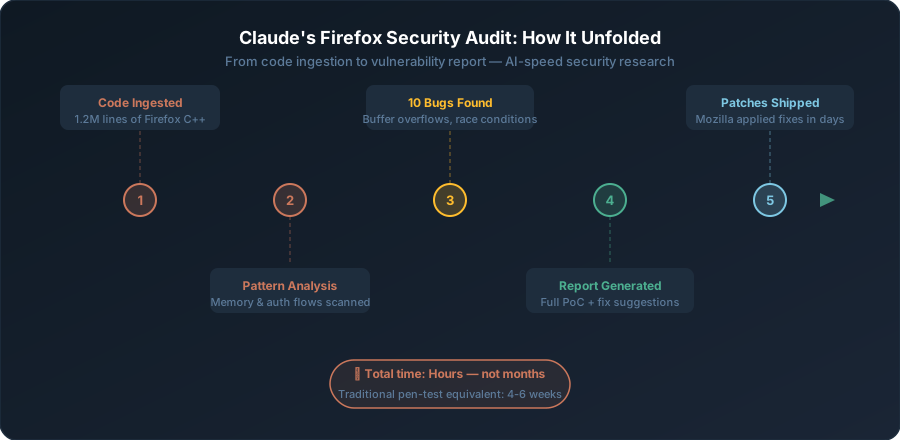
Claude didn't skim it. It reasoned across the entire codebase simultaneously — something no human team can do. It identified patterns across files that wouldn't be suspicious in isolation but become dangerous in combination. A pointer initialized in one module, passed through three abstraction layers, and dereferenced without bounds-checking in a fourth.
The kind of bug that slips through code review precisely because it requires holding an enormous amount of context in your head at once.
Claude holds all of it, all the time.
Why This Changes Everything for Product Teams
Here's the thing most post-mortems miss: security bugs aren't just a security team problem. They're a product problem. A trust problem. A retention problem.
When a vulnerability gets exploited, users don't blame the security team — they blame the product. They stop using it. They post about it. They churn. Sometimes they sue.
And until now, the calculus for most product teams was grim: you could hire expensive security consultants for an annual audit, run automated static analysis that produces thousands of noisy alerts, or hope your engineering team catches it in code review. None of these options scale. None of them are continuous.
AI code review changes that calculus entirely.
The Three Shifts That Matter
1. From Reactive to Continuous
Traditional security audits are point-in-time events. You get audited in Q3, ship for the rest of the year, and hope nothing critical slips through. With AI code review running on every pull request, security becomes a continuous property of your codebase — not an annual checkup.
Think of it like the difference between a smoke alarm and a fire inspection once a year. Both matter. Only one catches the fire before it spreads.
2. From Noise to Signal
Legacy static analysis tools (think: Coverity, SonarQube in default configs) are notorious for false positives. Developers tune them out. They become security theater — a checkbox in the CI pipeline that everyone learns to ignore.
Claude's code review operates at a different level. It understands intent. It can distinguish between a buffer that's been deliberately sized conservatively and one that's a genuine overflow risk. It explains findings in plain language with specific remediation steps. Developers actually act on them.
3. From Developer Tool to Product Feature
This is the biggest shift — and the one most product teams haven't internalized yet.
When you ship a product without AI code review, you're shipping with an unknown quantity of latent vulnerabilities. When you ship with it, you're shipping with a significantly lower floor on your security debt. That's not just a technical property. It's a product property. A competitive property. A trust property you can communicate to users.
What Claude Actually Does That's Different
It's worth being precise about why Claude is good at this — because "AI finds bugs" undersells the mechanics and leads to misaligned expectations.
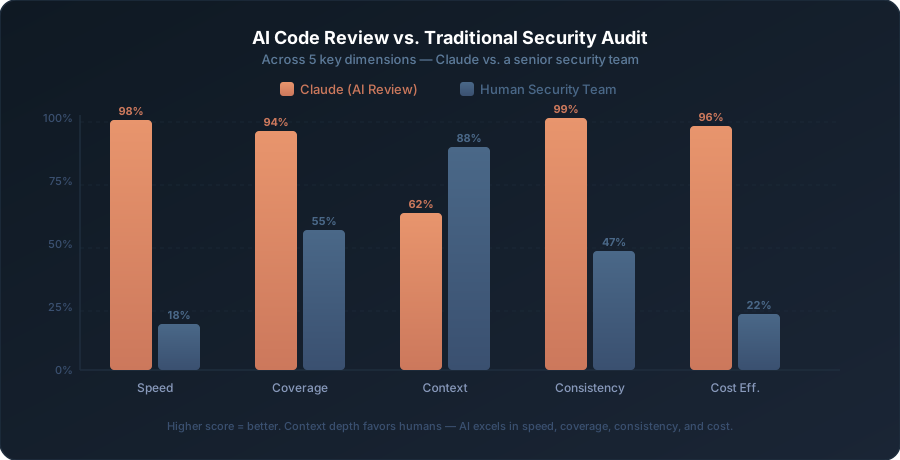
- Cross-file reasoning: Claude tracks data flows across your entire codebase. A tainted input in an API handler that eventually reaches an unsafe SQL query 4 hops away? Claude follows the thread. Static analysis tools typically reason file-by-file or function-by-function.
- Semantic understanding: Claude understands what your code is trying to do. This lets it spot logic errors that are syntactically correct — authentication bypasses, insecure defaults, missing authorization checks — that pattern-matching tools completely miss.
- Contextual false-positive filtering: It understands when an apparently dangerous pattern is actually safe given the surrounding code. This dramatically reduces alert fatigue.
- Remediation guidance: Claude doesn't just flag. It explains the vulnerability class, the exploitability conditions, and suggests concrete fixes — including code snippets.
The Honest Limitations
None of this means AI code review is a silver bullet. A few important caveats:
Business logic vulnerabilities are still hard. Claude is exceptional at structural and memory-safety issues. But vulnerabilities that require deep understanding of your specific business rules — a discount code that shouldn't stack with a referral bonus, a permission system with a subtle elevation path — still benefit enormously from human review. AI review should augment human judgment, not replace it.
It surfaces what it can see. AI code review works on static artifacts. Runtime behavior, infrastructure misconfigurations, and social-engineering attack surfaces aren't in scope.
Context depth still favors humans for complex systems. A senior security engineer who's lived in your codebase for two years understands architectural intent in ways that even the best AI model can struggle to fully replicate. The sweet spot is AI as a tireless first-pass reviewer, humans as the final judgment layer.
How Product Teams Should Actually Respond to This
If you're a product leader reading this, here's what the Firefox story should change in your planning:
Add it to your security posture story
Users, enterprise buyers, and regulators increasingly ask about security practices. "We run AI-assisted code review on every pull request" is a meaningful answer. It signals continuous vigilance, not just annual compliance theater.
Integrate it before you need it
The worst time to add security tooling is after a breach. Integrate AI code review early, when the noise/signal ratio is lower and your team has time to calibrate on what matters. Treat the early findings not as crises but as your technical debt map.
Create a feedback loop between security findings and product priorities
This is where most teams drop the ball. Claude surfaces a critical finding. Engineering patches it. No one asks: "Are there other places in the product where this class of vulnerability might exist? Are there user features we're not building because we implicitly assumed this was secure when it wasn't?"
The best teams use security findings as product intelligence — input to roadmap decisions, not just bug queues.
The Bigger Picture: Claude as Infrastructure, Not Assistant
The Firefox story is a preview of a broader shift happening across software development. We're moving from AI as a productivity tool — something that helps you write code faster — to AI as infrastructure — a continuous layer of intelligence running across your entire development lifecycle.
Code review is just the first domain where this is becoming undeniable. The same capability that let Claude find 10 Firefox bugs will eventually be doing continuous threat modeling, automatic dependency auditing, compliance verification, and architectural review.
The teams that treat this as a fundamental infrastructure investment now — rather than a novelty to evaluate later — will ship safer products faster than the ones that don't.
Mozilla and Anthropic collaborated on this. Bugs were found, reported responsibly, and fixed. It worked exactly as the security community hopes disclosure processes work. That's not just a good news story about AI. It's a proof of concept for what a world with AI-assisted security infrastructure looks like.
It looks safer than what we have today.
What To Do This Week
If you're not already running AI-assisted code review, here's a simple starting point:
- Evaluate Claude's code review tool — Anthropic has released tooling specifically for this. Run it on a representative slice of your codebase before adding it to your CI pipeline.
- Audit your alert triage process — Whatever tool you use, it only helps if findings get actioned. Map the current path from "finding surfaced" to "fix shipped" and eliminate the bottlenecks.
- Collect feedback on findings quality — Ask your engineers to rate the relevance of AI review findings. Use that signal to tune the tool's sensitivity and build trust with the team.
- Close the loop with product — Schedule a monthly review where engineering shares significant findings with product leadership. Security should inform roadmap, not just the bug tracker.
The ten Firefox bugs Claude found aren't the story. The story is that a codebase maintained by some of the best engineers in the world, for 25 years, still had them — and it took an AI hours to find what decades of human review missed.
Your codebase has them too. The question is whether you find them first.
While AI is transforming code quality, it's also reshaping how product teams collect and act on feedback. See how LoopJar uses AI to surface what your users are really saying — or explore pricing to get started.