
Context Collapse: Why AI Summaries Are Dangerous for Product Strategy
Generic AI tools summarize by volume, not value. Discover why 'Context Collapse' is leading product teams to build features for the wrong users—and how Value-Weighted Analysis fixes it.
Marcus Rodriguez
Growth Product Manager

You’ve just uploaded 500 support tickets to ChatGPT or a generic AI summarizer. You ask: "What are the top 3 feature requests?"
The AI instantly replies:
- Dark Mode (150 mentions)
- iPad App (80 mentions)
- Faster PDF Exports (40 mentions)
It seems obvious. You should build Dark Mode. The people have spoken!
So you build it. You ship it. And... your churn rate doesn't budge. Your revenue stays flat.
Why? Because you just fell victim to Context Collapse.
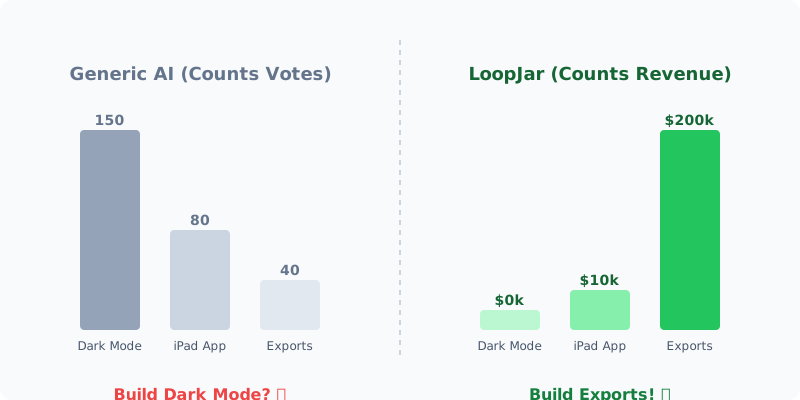
The Problem: AI Loves Volume, Business Loves Value
Generic Large Language Models (LLMs) are democratic. They treat every word, every sentence, and every user as equal. To an LLM, a complaint from a "Free Trial" user who signed up yesterday carries the exact same weight as a complaint from a "$50k/year Enterprise" customer who has been with you for 5 years.
In the example above, let's look at the Context the AI missed:
- Dark Mode (150 mentions): Mostly students on the Free plan who use the app at night. Revenue Impact: $0.
- iPad App (80 mentions): Hobbyists. Revenue Impact: Low.
- Faster PDF Exports (40 mentions): Your Finance Directors at Enterprise accounts who need to close their books monthly. They are threatening to churn. Revenue Impact: $200k/year.
The AI told you to build Dark Mode. A smart Product Manager would have built PDF Exports.
The "Flattener" Effect
When you strip away the metadata—User Role, Plan Tier, Lifecycle Stage, NPS Score—you flatten your customer base into a single, noisy blob.
This is dangerous because feedback volume is often inversely correlated with feedback value. Power users complain less, but their complaints matter more. Casual users complain constantly about trivial things.
If you automate your feedback loop without re-injecting this context, you are effectively optimizing your product for the loudest, least valuable users.
How LoopJar Solves Context Collapse
We believe AI needs to understand your business, not just your text.
1. Value-Weighted Analysis
LoopJar integrates with your CRM and Billing data (Stripe, HubSpot). When our AI analyzes a piece of feedback, it checks the "weight" of the user.
"This request matches 'Reporting', and it comes from a High-Value Segment." -> Priority Boosted.
2. Segmented Summaries
Instead of one global summary, LoopJar lets you ask segment-specific questions:
- "What do my Churned users hate?"
- "What do my Enterprise users want?"
- "What are Trial users confused by?"
The answers are usually completely different.
3. The "Revenue at Risk" Metric
We don't just show you "Number of Votes." We show you "ARR at Risk."
If 5 users ask for a feature, but those 5 users represent 20% of your revenue, that feature bubbles to the top of your roadmap instantly.
Conclusion
Don't let AI flatten your strategy.
Speed is good, but context is king. If you want to build a product that grows revenue, not just "user happiness," you need a feedback engine that knows the difference between a user and a customer.
Stop summarizing words. Start summarizing value. Try LoopJar today.