
Product Feedback Loops: What LinkedIn and Industry Reports Reveal About Winning Teams
New data from LinkedIn, Forrester, Gartner, and McKinsey shows that companies with mature feedback loops grow 60% faster. Here's the full breakdown—and what it means for your product strategy.
Priya Sharma
Head of Product Intelligence
In early 2026, LinkedIn published its latest Work Change Report alongside a surge of thought leadership on product management. One pattern jumped off the page: the companies outperforming their markets all share a single discipline—a closed, data-driven product feedback loop.
Meanwhile, Forrester's CX Index, Gartner's CPO Priority report, and McKinsey's product-development research all point in the same direction. The teams that systematically collect, analyze, act on, and close the loop on customer feedback are not just building better products—they're growing revenue faster, retaining customers longer, and making decisions at speed.
In this article we unpack the data, visualize the frameworks, and show you exactly how to operationalize these insights.
The Five-Stage Feedback Loop
Before we dive into the numbers, let's align on what a product feedback loop actually looks like when done right. It isn't a suggestion box or a Slack channel. It's a repeatable, measurable system.
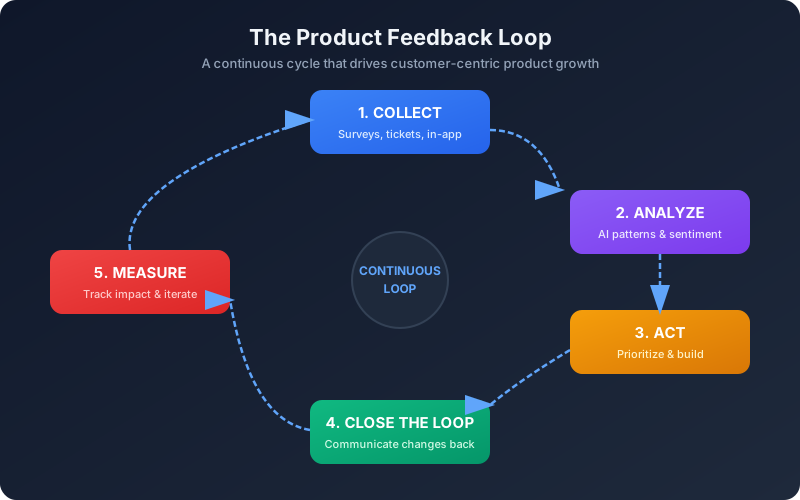
The five stages are:
- Collect — Gather feedback from every channel: in-app widgets, support tickets, sales calls, surveys, social media, and community forums.
- Analyze — Use AI-powered sentiment analysis and pattern recognition to surface themes, not just count votes.
- Act — Prioritize features and fixes based on business impact (revenue at risk, segment value) rather than raw volume.
- Close the Loop — Communicate back to customers: "You asked, we built." This single step increases trust and future participation by up to 3×.
- Measure — Track adoption, retention, and revenue impact of changes, then feed results back into the next cycle.
What the Reports Say: The Hard Numbers
Across four major research sources, the ROI of a mature feedback loop is staggering.

60% Higher Profits
Research cited by Pactx and Gartner in 2025 found that businesses prioritizing customer feedback loops achieve 60% higher profits than those that ignore customer input. The mechanism is straightforward: when you build what paying customers actually need, you reduce wasted engineering cycles and increase willingness to pay.
41% Faster Revenue Growth
Forrester's US Customer Experience Index labels companies that obsess over customer feedback as "customer-obsessed"—and they grow revenue 41% faster than their peers. This isn't correlation; Forrester tracked spending behavior against CX maturity scores over multiple years.
40% Faster Product Decisions
According to research aggregated by InfluenceFlow (2026), companies with organized, AI-assisted feedback systems make product decisions 40% faster than teams relying on spreadsheets and gut instinct. When feedback is pre-categorized, deduplicated, and weighted, product managers spend less time arguing and more time shipping.
25% Higher Customer Retention
Formbricks' research shows companies with effective feedback loops see 25% higher retention rates. Why? Because when customers feel heard—and see their input reflected in the product—they stay. It's that simple.
23× Faster Customer Acquisition
Perhaps the most striking number: companies using instant data analysis with feedback loops gain new customers 23 times more frequently than rivals (Pactx, 2025). Word-of-mouth from satisfied customers, combined with faster iteration, creates a compounding growth engine.
The LinkedIn Signal: Why "Feedback Fluency" Is Now a Top Skill
LinkedIn's 2026 "Skills on the Rise" report reveals that nearly half of recruiters now use skills-based data to fill roles—and among the fastest-growing competencies are cross-functional collaboration, data storytelling, and customer empathy. All three are core to running an effective feedback loop.
Meanwhile, LinkedIn's own product team shared that after redesigning their messaging experience using tight user-feedback cycles, they achieved a 240% increase in messages sent—their most significant engagement jump in years. The platform's desktop redesign—"the largest redesign since LinkedIn's inception"—was driven by continuous feedback analysis, not top-down directives.
The message is clear: feedback-loop fluency is becoming a career-defining skill, not just a product-management nice-to-have.
The Maturity Gap: Where Most Teams Get Stuck
Not all feedback loops are created equal. Based on patterns from Gartner and LinkedIn's thought leadership, we've mapped four levels of maturity.

The uncomfortable truth: 73% of companies are still at Level 1 or Level 2. They collect feedback, but it sits in silos. They tag it manually, but never close the loop. They review it quarterly instead of continuously.
The gap between Level 2 ("we have a tool") and Level 3 ("we have a system") is where most product teams lose the competitive race. Crossing that gap requires three things:
- Centralization: All feedback in one place—not scattered across Intercom, Slack, Jira, email, and sticky notes.
- Automation: AI-powered categorization, deduplication, and sentiment analysis to eliminate the manual grind.
- Accountability: Every piece of feedback gets a status—acknowledged, planned, shipped, or declined with a reason.
What McKinsey and Gartner Say About AI + Feedback
McKinsey's 2025-2026 product development research reports that AI is compressing development timelines by up to 60%. Generative AI enables faster consumer sentiment analysis, trend identification, and even concept testing with synthetic personas.
Gartner's 2026 CPO Priority report pushes further: chief product officers need to move beyond "adding AI to existing processes" and toward using AI to fundamentally reimagine how feedback flows into product decisions. That means:
- Real-time clustering of feedback themes (not monthly tag reviews)
- Revenue-weighted prioritization (not vote counting)
- Predictive churn signals from feedback sentiment trends
- Automated "close the loop" communications when features ship
This is the shift from reactive feedback management to predictive product intelligence.
The Customer Expectation Crisis
Here's the number that should keep every product leader up at night: by 2025, 65% of customers expect businesses to adapt to their shifting needs, yet 61% feel treated as statistics rather than individuals (Pactx, citing Salesforce research).
That 4-point gap—between what customers expect and what they experience—is the "feedback dead zone." It's where churn festers, NPS drops, and competitors swoop in.
Closing that gap doesn't require more surveys. It requires a system that makes every piece of feedback visible, actionable, and traceable.
How to Build a Winning Feedback Loop in 2026
Based on the combined insights from LinkedIn, Forrester, Gartner, and McKinsey, here's a practical playbook:
Step 1: Consolidate Your Channels
Map every place feedback currently arrives—support tickets, NPS surveys, in-app widgets, sales call notes, social media mentions, G2/Capterra reviews. Feed them into a single system of record.
Step 2: Let AI Do the Heavy Lifting
Use AI to automatically categorize, deduplicate, and assess sentiment. This alone can save product teams hundreds of hours per month (InfluenceFlow, 2026). Focus human attention on interpretation and strategy, not sorting.
Step 3: Weight by Business Value
Integrate your feedback tool with CRM and billing data. A request from a $50k ARR enterprise client threatening to churn should outweigh 100 votes from free-tier users. This is revenue-weighted prioritization—and it's what separates Level 3 teams from Level 2.
Step 4: Close the Loop—Every Time
When you ship a feature that was requested, tell the people who asked for it. Forrester's research shows this single act increases willingness to provide future feedback by up to 3×. It's the cheapest retention strategy you have.
Step 5: Measure and Iterate
Track the downstream impact of feedback-driven changes: adoption rate, retention delta, revenue impact. Feed these results back into your prioritization model. The loop is only as good as its measurement layer.
The Bottom Line
The data from LinkedIn, Forrester, Gartner, and McKinsey converges on a single insight: product feedback loops are no longer optional—they're the primary driver of competitive advantage.
Companies at the top of the maturity curve grow faster, retain more customers, and make decisions with confidence instead of guesswork. The rest are flying blind.
The question isn't whether you need a feedback loop. It's whether the one you have is fast enough, smart enough, and closed enough to keep up.
Ready to move from Level 1 to Level 4? LoopJar gives you AI-powered feedback collection, revenue-weighted analysis, and automated loop-closing—all in one platform. Start your free trial today.