
Feedback-Driven Revenue: Ideation Playbook for March 2026 (From Reddit & X)
Product and GTM leaders are treating public threads as live demand labs. Here is a practical framework for turning noisy feedback—from Reddit, X, and your own product—into pricing, packaging, and roadmap bets that move MRR.
Alex Kumar
Product Strategy Lead

Customer feedback is not just a list of feature requests—it is one of the cheapest ways to test what people will pay for before you commit engineering months. This week we synthesized patterns from founder-heavy discussions on Reddit and X (Twitter), alongside what we see from teams using unified feedback systems. The goal: ideation you can use in your next pricing or roadmap review.

What Reddit is good for: unfiltered willingness to pay
Communities like r/SaaS, r/startups, and vertical subreddits behave like ongoing focus groups—messy, argumentative, and often more honest than a polished sales call. Industry reporting on Reddit’s scale (hundreds of millions of weekly users and billions of comments in 2025) underscores why these threads show up in so many competitive scans: demand signals are continuous, not quarterly.
Recurring themes from PM and founder threads include:
- Pricing and packaging in plain language — Users compare tiers, call out “nickel and diming,” and describe when they would upgrade. That language is gold for value metrics and packaging copy.
- Integration and workflow pain — “If it worked with X, we’d pay” is a bundled-offer hypothesis, not just a feature ticket.
- Organic discovery stories — Case-style posts on scaling MRR from community often stress help-first participation before pitching—useful for your own community-led growth experiments.
One pattern matches what we hear from product teams everywhere: by the time feedback is summarized for leadership, the nuance is gone. Reddit forces you to read how people argue with each other—which objections repeat, which workarounds they accept, and what they call a dealbreaker.
“We had feedback from five channels; by the time we synthesized it, the insights were stale.”
What X (Twitter) adds: speed, narrative, and GTM risk
X is noisy, but it compresses time: pricing changes, API shifts, and PLG vs. sales debates surface in hours, not weeks. Marketing and growth analysis in the B2B space often emphasizes qualified demos and pipeline quality over vanity engagement—analogous to how you should treat social feedback: weight signals that tie to accounts, segments, or repeatable revenue stories.
Recent discourse around usage-based API pricing on X-adjacent tech coverage illustrates another point: when a platform changes how it charges, the feedback loop between price, developer behavior, and revenue becomes explicit. You may not run an API business, but the same dynamic applies to seats, credits, and overage—customers tell you when the meter feels fair.
Practical takeaway: use X for hypothesis generation and language (how buyers frame pain); use your CRM and product analytics for validation.
A simple matrix: impact × revenue signal
Not every loud request deserves the roadmap. Before ideation workshops, we map themes from feedback (including public sources) onto two axes: customer/market impact and revenue signal (willingness to pay, expansion potential, churn prevention).
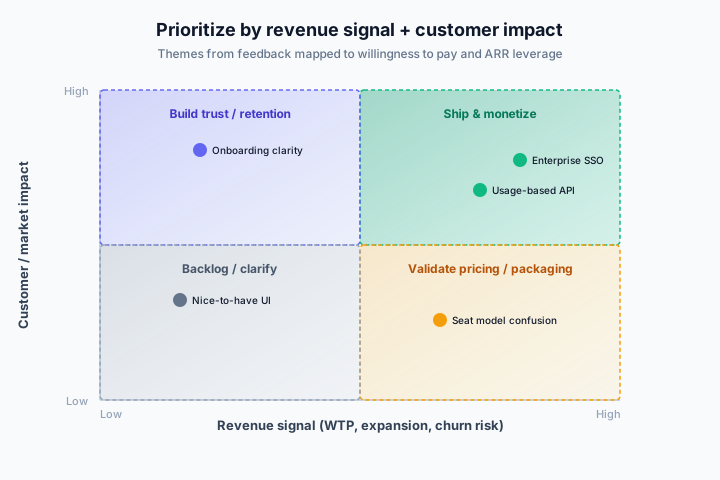
- Ship & monetize (high / high): Security, governance, and integrations often land here for B2B—buyers budget for them.
- Build trust / retention (high impact, softer $ signal): Onboarding and reliability work—justify via retention and expansion cohorts, not immediate upsell.
- Validate pricing / packaging (softer impact, high $ signal): Confusion about tiers or meters—fix with packaging before you build net-new surface area.
- Backlog / clarify (low / low): Nice-to-haves—capture but starve until evidence improves.
Five ideation prompts for your next revenue review
- “What job would customers hire a paid add-on to do?” Mine Reddit and support for workarounds; workarounds indicate latent WTP.
- “Which requests correlate with enterprise or high-ACV accounts?” Weight feedback by segment, not vote count alone.
- “What language do people use for outcomes vs. features?” Outcome language belongs in packaging; feature lists belong in release notes.
- “Where do we lose deals in the words of buyers?” Sales notes + public threads together reveal positioning gaps.
- “What would we meter if we moved to usage?” Even if you stay flat-rate, the exercise clarifies value drivers.
Unify public and private signals
Reddit and X are inputs, not sources of truth. They lack account context unless you connect them to your stack. The durable setup is one model where themes from anywhere can be compared to revenue and retention data.

Closing the loop is part of the revenue story
When customers see their feedback influence roadmap and commercial decisions (what is standard vs. paid), they are more likely to engage again—and engagement lowers CAC for future research. Closing the loop is not fluff; it increases the quality of the next round of signals.
Bottom line: Treat Reddit and X as large, messy panels for ideation and language. Treat your product and revenue systems as the place where ideas become measurable bets. The teams that win in 2026 will wire both sides together—not choose between them.