
The Feedback Triage Engine: How to Build an LLM Scoring System That Separates Signal from Noise
Not all feedback is equal — but most teams treat it that way. An LLM triage engine scores every incoming item across six quality dimensions automatically, so your roadmap is shaped by the best signals, not the loudest voices.
Alex Chen
Head of Product
A bug report with exact repro steps from a 500-seat enterprise account on the day before renewal is not the same signal as "would be nice if..." from a free trial user who signed up yesterday. Both arrive in the same queue. Both get read by the same product manager. In most teams, the difference between them is invisible until someone manually digs into account context — which almost never happens before the feedback gets tagged and filed.
This is the feedback quality problem, and it compounds fast. As volume grows, the signal-to-noise ratio in the backlog degrades. Priorities drift toward items that accumulated the most votes rather than items with the most strategic weight. Product decisions get made on a distorted picture of what customers actually need.
An LLM triage engine fixes this at the source. Every incoming feedback item is scored across multiple quality dimensions before any human reads it. High-quality signals surface immediately. Low-quality noise gets routed to a review queue or archived outright. The PM's queue contains only items worth their time — and every item arrives with a structured rationale attached, not just a tag.
Why Volume-Based Prioritization Fails
The standard response to the feedback quality problem is voting. More votes means more demand, which means higher priority. This logic is intuitive, but it breaks in predictable ways.
Voting surfaces popularity, not importance. A cosmetic annoyance experienced by casual users in a free tier accumulates votes faster than a workflow-blocking issue felt by five enterprise accounts that never post publicly. The enterprise customers file a support ticket, mention it on a call, and eventually leave — while the cosmetic issue sits at the top of the roadmap because it resonated with a vocal slice of the user base.
Manual tagging has the same problem from a different angle. Tags are only as consistent as the person applying them, and that consistency degrades under volume. Two different team members will categorize the same feedback differently. The same team member will categorize it differently on Monday morning versus Friday afternoon. Over time, your taxonomy diverges from your actual data, and queries against it return unreliable results.
The underlying issue is that neither votes nor tags capture signal quality. A single piece of feedback can be highly specific, immediately actionable, and strategically critical — or it can be vague, duplicative, and irrelevant to anyone but the person who wrote it. Treating these as equivalent inputs and letting volume decide their fate is a structural prioritization flaw, not a workload problem.
Six Dimensions of Feedback Quality
Before you can score feedback, you need a model of what makes feedback good. Six dimensions cover most of the signal quality space:
1. Specificity
Does the feedback describe the exact problem, or is it general frustration? "The export button in the analytics dashboard doesn't work in Firefox 124" is high specificity. "The export feature is bad" is not. Specific feedback gives the engineering team something to act on without a follow-up conversation. General feedback requires an investigation just to understand what is being reported.
2. Reproducibility
For bug reports and usability issues: can the team recreate the problem from the description given? Feedback with steps to reproduce, environment details, or screenshots scores higher than feedback that describes a symptom without context. This dimension is most relevant for technical issues but also applies to workflow complaints — "I tried to do X and couldn't" is more reproducible than "X doesn't feel right."
3. Impact Scope
How many users or accounts are affected? A single-user edge case scores lower than a workflow that every account relies on daily. This dimension requires enriching the feedback item with account context — the LLM alone cannot assess this; it needs a tool call to check account size, tier, and feature usage to evaluate impact scope accurately.
4. Actionability
Is there a clear thing the product team can actually do? Feature requests that describe the desired outcome score higher than requests that describe a feeling. "Let me filter the report by custom date range" is actionable. "The reports are not useful for our team" is not, without follow-up. Actionable feedback can go directly into a spec; non-actionable feedback requires a discovery conversation before it can inform any decision.
5. Novelty
Is this a new signal, or a duplicate of something already in the backlog? An LLM can assess this by searching prior feedback and roadmap items for semantic similarity. Novel feedback deserves attention because it expands the problem space. Duplicate feedback is still valuable as a signal of volume, but it should be linked to the existing item rather than creating a new thread in the backlog. Treating every duplicate as a fresh item inflates perceived demand without adding information.
6. Urgency
Is there a time constraint that changes the calculus? Feedback from an account with a renewal in 30 days carries urgency that identical feedback from a recently-onboarded account does not. Feedback triggered by a recent release is more urgent than feedback about a long-standing limitation. Urgency does not change the strategic importance of an item, but it changes the response window — and missing that window has consequences that compound.
Building the Scoring System
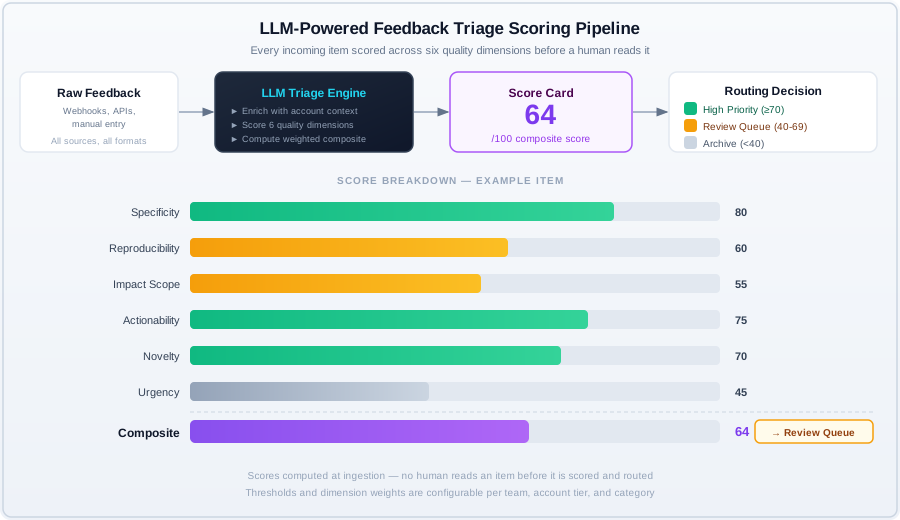
The scoring pipeline has three stages: enrich, score, and route. Each stage has a clear responsibility and a well-defined output format.
Stage 1: Enrichment
Before the LLM evaluates quality, the feedback item needs account context attached. Raw feedback text alone cannot score Impact Scope or Urgency — you need to know who sent it. An enrichment step makes tool calls to fetch account tier, seat count, health score, renewal date, and active feature set. This data gets included in the scoring prompt as structured context. Without it, the judge is working with one hand tied behind its back.
Stage 2: LLM Scoring
The scoring prompt asks the model to evaluate the feedback item against each of the six dimensions and return a JSON object with a score from 0–100 and a one-sentence rationale for each. The prompt uses chain-of-thought reasoning — the model first describes what it observes about each dimension, then commits to a score. This produces more accurate scores than asking for a number directly, and the rationale makes each score auditable and useful for calibration.
The composite score is a weighted average. Weights should reflect your team's actual prioritization values — a developer tools product might weight Reproducibility and Specificity more heavily, while a B2B enterprise product might weight Impact Scope and Urgency above all others. Start with equal weights and adjust based on the cases where the model's routing decisions disagreed with what your team would have done.
The diagram below shows the full scoring pipeline, with an example item broken down across all six dimensions:
Stage 3: Routing
Composite score thresholds determine where the item goes. A score at or above 70 routes to the high-priority queue — direct PM attention, same-day review. Scores between 40 and 69 go to the review queue — PM reads during the next triage block. Scores below 40 go to an archive with the rationale attached, so the PM can audit the decision rather than just accepting a black box. These thresholds are starting points; every team calibrates them differently once they see what the model produces on their actual data.
Calibrating the Judge
An LLM scoring system is only as trustworthy as its alignment with your team's actual judgment. The cold start problem is real: the model's first week of output will contain decisions you disagree with, and those disagreements are the most valuable data you will produce during deployment.
The calibration process is straightforward. For the first two weeks, every item the model routes to High Priority or Archive gets a human review. When the human routing decision differs from the model's, you log the item, the model's rationale, and your override reasoning. After two weeks, you have a calibration set of 20–50 disagreements. Feed these back into the prompt as few-shot examples — items the model got wrong, with the correct score and the reasoning that should have led to it. This single step typically cuts the disagreement rate in half.
Ongoing calibration should be lightweight. One weekly review of a random sample of 10 routed items — five from each threshold bucket — keeps the system honest as your product and customer base evolve. When a new account segment starts generating unusual feedback patterns, the calibration sample will surface it before it distorts your roadmap.
What Changes When You Deploy This
The first thing teams report after deploying a triage engine is not faster backlog processing — it is quieter PM work. When the queue contains only pre-scored, pre-routed, context-enriched items, triage becomes a review rather than an investigation. A PM who spent four hours per week reading and categorizing raw feedback can complete triage in 45 minutes, because every item arrives with its account context, its quality rationale, and its routing recommendation already prepared. The human role shifts from sorting to deciding.
The second change is upstream: feedback collection quality improves. When your system starts surfacing scores, the team can see in aggregate which sources produce high-specificity signals and which produce noise. Support tickets from the in-app feedback widget might consistently score 30 points higher on Specificity than app store reviews, because the in-app context is richer. This drives a deliberate decision about where to invest in collection — better in-app prompts, clearer survey questions, targeted follow-up for low-specificity submissions — rather than accepting whatever comes in as equally valid input.
The third change is harder to measure but more important: product decisions get made on better information. When your roadmap is shaped by the highest-quality signals rather than the loudest voices, the features you build match the problems your customers actually have. Fewer "why did we build that" retrospectives. More releases that drive measurable adoption from the accounts that mattered most to the decision.
What the System Cannot Do
A triage engine scores quality, not strategic value. A highly specific, reproducible, actionable bug from a critical enterprise account might still not belong on the roadmap if fixing it requires re-architecting a subsystem that the team has already decided to replace. Quality score tells you the signal is good. It does not tell you the signal belongs in your current strategy.
The model also cannot score dimensions that require information it does not have. If your enrichment step does not supply account context, the Impact Scope and Urgency scores will be guesses. If your feedback collection system does not capture the user's workflow or environment, Reproducibility scores for complex issues will be underestimates. The quality of the scoring output is directly proportional to the quality of the context fed to the model — which is a statement about data collection, not AI capability.
Finally, the rationale the model provides for each score is a useful audit trail, but it is not a substitute for human judgment on edge cases. When the composite score lands near a threshold — 38, 41, 68, 72 — treat it as a signal to review, not as a decision. The model is most confident at the extremes, and least reliable in the middle of the range where the dimensions genuinely point in different directions. That ambiguity is exactly where human context adds the most value.
Getting Started Without Overthinking It
The minimum viable triage engine is a single scoring prompt, a webhook to run it on every new feedback submission, and a Slack channel where high-priority items get posted automatically. You do not need to build the full pipeline on day one. Start with three dimensions — Specificity, Actionability, and Impact Scope — and a simple threshold. Get a week of data. See where the model's routing matches your intuition and where it doesn't. Calibrate from those disagreements. Add dimensions as your confidence in the base scoring grows.
The teams that get stuck are the ones waiting to design the perfect scoring rubric before shipping anything. The perfect rubric does not exist before you have seen how your specific customers write feedback. Ship the simplest version that captures the worst noise and the clearest signal, and let your calibration data tell you what the second version should look like.