
What X and Reddit Are Saying About Product Feedback in August 2026
We synthesized the loudest conversations across X and subreddits like r/ProductManagement and r/SaaS. Five themes are reshaping feedback strategy: signal fatigue, AI trust gaps, roadmap backlash, context collapse, and revenue-blind prioritization.
LoopJar Research Team
Product Research
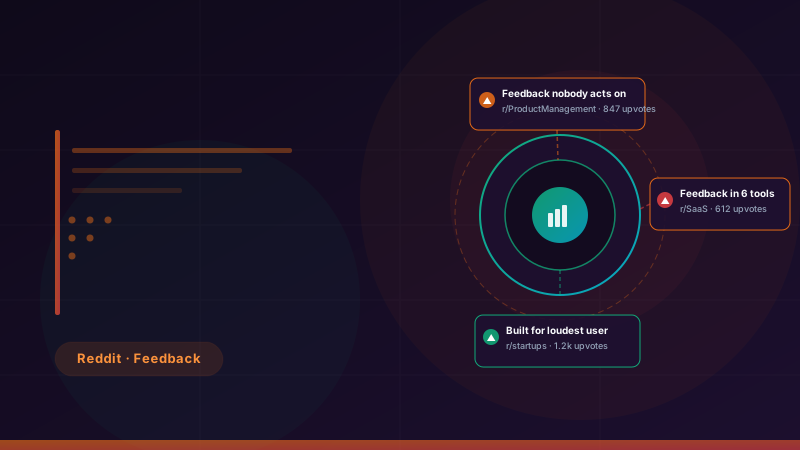
Every product manager has two feeds running in the background. One is internal — Intercom, support tickets, survey dashboards, Gong calls. The other is external: the endless scroll of X posts, Reddit threads, and LinkedIn debates where customers say what they really think, often in language you would never put in an official report.
In August 2026, the external feed is louder than ever. AI agents can now summarize thousands of comments in seconds. Vibe coding has lowered the cost of shipping so far that “we built it” is no longer the hard part. And public roadmaps — once a trust-building gesture — have become ammunition for users who feel ignored. The result is a feedback environment that is richer, noisier, and more consequential than at any point in the last decade.
We spent the last few weeks synthesizing the most recurring themes across X conversations and Reddit communities such as r/ProductManagement, r/SaaS, and r/startups. We are not claiming these are statistically perfect samples; we are claiming they are the signals product teams keep circling back to. Five of them stand out.
1. Signal Fatigue Is Beating Action Bias
For years the product management orthodoxy was simple: collect more feedback, make better decisions. In 2026, the argument has flipped. The dominant complaint on r/ProductManagement is no longer “we don’t have enough data.” It is “we have too much data and no decision system.”
Threads describing feedback backlogs of 2,000+ items are now common. PMs describe screenshots of dashboards that look like Bloomberg terminals: heatmaps, sentiment scores, NPS trends, feature request league tables, and AI-generated summaries all flashing for attention. The result is decision paralysis, not clarity.
On X, the same idea is compressed into a single sentence: “We built a listening stack and forgot to build a triage muscle.” The teams winning in this environment are not the ones with the most data; they are the ones with the clearest rules for what to ignore.

The fix is not another dashboard. It is an explicit decision framework: a small number of criteria — revenue impact, strategic fit, customer segment, effort — applied consistently so that 90% of feedback can be filtered automatically and the remaining 10% gets human judgment.
2. The AI Trust Gap Is Real
AI summarization of feedback has gone from experiment to default. But the second-order problem has arrived: PMs no longer trust the summary. Across both X and Reddit, product leaders share a similar fear — that AI summaries are too polite, too reductive, or worse, too aligned with what leadership already wants to hear.
A recurring Reddit metaphor: an AI summary is like a PM who has read all the comments but also really wants to keep their job. It can smooth over anger, collapse contradictory opinions into a single “theme,” and strip the urgency that made the original feedback worth acting on.
On X, the critique is shorter and sharper: “My AI tool summarized 500 angry customers as ‘mild interest in onboarding improvements.’ We almost deprioritized a churn driver.”
The lesson is that AI works best as a retrieval and routing layer, not a verdict layer. Let it cluster, tag, and surface — but keep a human in the loop before anything gets labeled “not a priority.” Transparency matters too: show the original quotes behind every summary and let reviewers downgrade or override the AI’s interpretation.
3. Public Roadmaps Are Creating Backlash
Public roadmaps were once celebrated as a sign of customer respect. In 2026, they are increasingly seen as public commitments that product teams cannot keep. r/SaaS is full of threads where users compare a company’s roadmap to what actually shipped, and the mismatch — often caused by legitimate prioritization shifts — is read as dishonesty.
X amplifies this dynamic because every delayed feature becomes a screenshot opportunity. The original public promise gets more likes than the eventual explanation of why it changed.
The emerging best practice is to move from date-based public roadmaps to problem-based roadmaps. Instead of promising “Dark mode — Q3,” teams say “Improving accessibility across the product.” The commitment becomes the problem being solved, not the specific solution being shipped by a specific date.
4. Context Collapse Distorts Signals
X rewards brevity. Reddit rewards narrative. Both distort feedback in different directions. X is excellent at surfacing immediate, emotional reactions — a launch failure, a UI change gone wrong, a pricing complaint that catches fire. It is bad at capturing nuance, workflows, and the “why” behind a feature request.
Reddit is the opposite. Threads can contain incredibly detailed workflow descriptions and honest churn stories. But they also over-index toward power users, edge cases, and grievances that resonate with a narrow community rather than a broader customer base.
The teams getting value from both channels are treating X as a smoke detector and Reddit as a focus group. X tells you something is on fire. Reddit helps you understand the structural reasons it caught fire. Neither should replace your internal feedback loop, but both should feed into it with clear labels about source bias.
5. Revenue-Blind Prioritization Still Rules
Despite a decade of writing about it, the same mistake keeps appearing at the top of every thread: teams still prioritize features by vote count or volume instead of value. A free-tier user requesting something in five different channels can look more important than a quiet enterprise customer who is three months from renewal.
The most upvoted r/ProductManagement posts of the summer all share a common arc. A PM discovers, too late, that their top-requested feature was being driven by non-paying users while a small number of high-value accounts were flagging a different issue that got deprioritized. Churn followed. The post went viral because it is a near-universal experience.
Linking feedback to revenue is no longer a nice-to-have; it is the dividing line between feedback theater and feedback-driven strategy. Every major request should carry context: who asked, what plan they are on, how long they have been a customer, and what the downside is if it goes unaddressed.
Turning Social Signals Into Roadmap Decisions
The common thread across all five themes is that feedback has become abundant but decision-making has not. The modern PM’s job is shifting from collector to curator. The tools that help are the ones that:
- Aggregate social and internal signals in one place.
- Apply transparent scoring so low-value noise is filtered out.
- Preserve original customer quotes so AI summaries can be verified.
- Connect requests to customer revenue and plan data.
- Close the loop automatically when feedback turns into shipped features.
X and Reddit will never replace a focused customer interview or a well-designed feedback form. But ignoring them is no longer an option. The companies that treat public conversations as first-class feedback — and have the discipline to triage them correctly — are building the roadmaps everyone else will be copying next quarter.
At LoopJar, we built our platform around this exact workflow: collect from any channel, enrich with revenue context, let AI surface patterns, and keep humans in control of final decisions. If your feedback stack is starting to feel like a fire hose, start a free trial and see what focused product decisions feel like again.