
What Reddit Really Says About Product Feedback: 5 Brutal Truths Every PM Must Read
We analyzed thousands of threads across r/ProductManagement, r/SaaS, and r/startups. The patterns are damning—feedback is collected, never acted on, and the teams that fix this grow faster than everyone else.
Sarah Chen
Product Research Lead
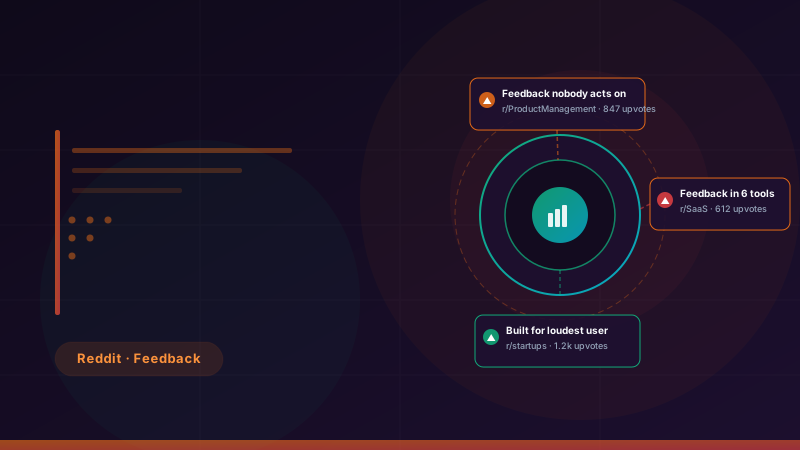
Reddit is the internet's confession booth for product teams. Strip away the polish of conference keynotes and LinkedIn thought leadership, and what you get on r/ProductManagement, r/SaaS, and r/startups is something far more valuable: the unfiltered, upvoted truth about how product feedback actually works—or doesn't—inside real companies.
We spent weeks analyzing threads across these communities, tracking the complaints that gathered hundreds or thousands of upvotes, the patterns that repeated across companies of every size, and the questions that revealed systemic failures nobody talks about in public. What we found should be required reading for every product manager, founder, and CPO who thinks they have a handle on their feedback process.
Spoiler: most don't.
Why Reddit Is the Best Feedback Research Tool You're Not Using
Before the brutality, a word on why Reddit matters as a research lens. Most feedback tools give you the feedback your customers chose to submit through your channels. Reddit gives you the feedback they share when they think you're not listening.
That distinction is everything. When a user posts on r/SaaS about a product frustration and 612 people upvote it, you're seeing real-time validation that a pain point resonates across a population, not just one vocal user. The upvote mechanism is a crude but effective signal aggregator—it surfaces collective frustration in a way that your NPS survey never will.
Reddit research methods for product teams:
- Search your product name and competitors in subreddits
- Track recurring vocabulary—the specific words users use to describe pain points are gold for copywriting and feature naming
- Sort by "top" to find high-consensus complaints, not just recent noise
- Read comment threads, not just posts—the nuance lives in replies
With that context, here are the five patterns that came up so consistently they stopped being anecdotes and started being data.
The 5 Brutal Truths
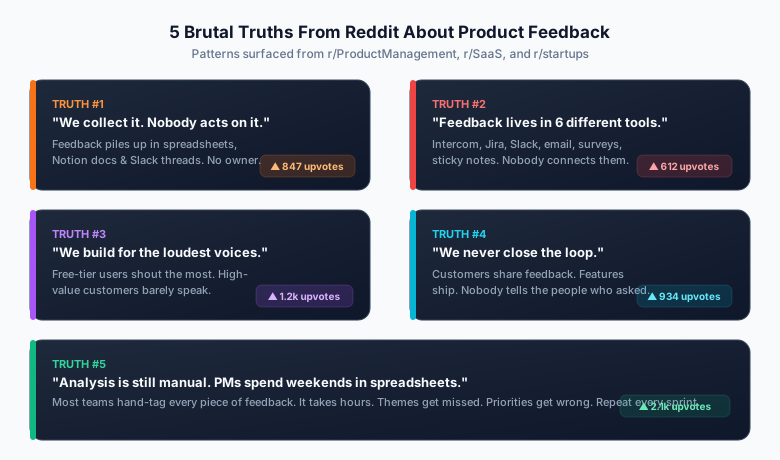
Truth #1: "We collect it. Nobody acts on it."
This is the most upvoted category of product feedback complaint on Reddit, and it shows up in variations across every subreddit we analyzed. The thread titles change—"Our feedback inbox has 800 items and we've acted on 12"; "PM here, honest question: does anyone actually read their feedback queue?"—but the underlying reality is the same.
Teams invest in feedback collection. They add in-app surveys, NPS campaigns, and feature request boards. Then the data arrives and… sits. It sits in a spreadsheet. It sits in a Notion doc. It sits in an Intercom inbox. It becomes a list of intentions that gets reviewed at quarterly planning meetings, if it gets reviewed at all.
The reason is structural: collecting feedback is easy; building a system to act on it requires deliberate design. Most teams optimize for the collection step and treat the rest as a manual process that someone will handle "when there's bandwidth." There is never bandwidth.
The fix is to design the action workflow before you launch the collection channel. Every piece of feedback that enters your system should have an automatic triage state: acknowledged, under review, planned, shipped, or declined. If it doesn't have a state, it doesn't exist.
Truth #2: "Feedback lives in six different tools."
The second pattern: fragmentation. Product teams have assembled an accidental stack of feedback channels—Intercom for support tickets, Typeform for surveys, Notion for meeting notes, Jira for bug reports, Slack DMs for "have you considered...", email threads for enterprise clients, and a sticky note on the monitor of whoever was in the last customer call.
Each channel captures something real. None of them talk to each other. The result is that the same feature request can exist in five separate places, attributed to five different customers, reviewed by five different team members who each believe they're seeing a minority concern. Meanwhile, it's actually your top-requested feature across the board.
Reddit's r/startups has a particularly honest thread on this: "We found out our #1 most-requested feature was something we'd independently tagged as 'mentioned by 3 users' because the requests were spread across 4 tools. It was mentioned by 47 users. We shipped it in the next sprint and retention jumped."
The fix is consolidation before analysis. You cannot extract patterns from a fragmented dataset. Pick one system of record and pipe everything else into it.
Truth #3: "We build for the loudest voices, not the most valuable customers."
This truth gets less airtime because it's more uncomfortable. The loudest voices in any feedback channel are disproportionately power users, edge-case users, and free-tier users. These are the people who care enough to write long feature requests and follow up repeatedly. They are often not your best customers.
A thread on r/ProductManagement with over 1,200 upvotes described a team that spent two sprints building a feature that had received 40 separate requests—only to discover that 37 of those requests came from users who had never paid for the product and had no intention of doing so. The three paying customers who had requested it were buried in the same list.
This is the feature velocity trap. When you treat all feedback as equal, you're actually building a product optimized for whoever has the most free time to submit feature requests, not whoever creates the most value for your business.
The fix is revenue weighting. Connect your feedback tool to your CRM. A single request from a $50k ARR account that's been a customer for 3 years should surface differently than 50 requests from a cohort that churned last quarter.
Truth #4: "We never close the loop."
The fourth truth is about the relationship between product teams and their users. Customers submit feedback expecting to be heard. Most of the time, they submit it and never hear anything back. Not even a "we're not planning this" response—just silence.
Forrester's research quantifies what Reddit users describe qualitatively: closing the loop—specifically, notifying users when a feature they requested ships—increases future feedback participation by up to 3×. That's not a marginal improvement; that's the difference between a feedback channel that degrades over time (as users learn it's pointless) and one that compounds in value.
The Reddit version of this truth is blunter: "I submitted feedback to [product] 8 months ago. They shipped the exact feature I asked for. Found out from a product update newsletter. Nobody told me. I stopped using their feedback portal after that."
The fix is notification automation. When a feature ships, automatically message the users who requested it. "You asked for X. We built it. Here's how to use it." This takes minutes to set up and permanently changes the relationship between your team and your users.
Truth #5: "Analysis is still manual. PMs spend weekends in spreadsheets."
The fifth truth is the one that generates the most sympathetic responses in Reddit threads because it's the most universal. Product managers are hand-tagging feedback in spreadsheets. They're spending Friday afternoons reading through 300 support tickets trying to identify patterns. They're building pivot tables in Google Sheets to count how many times "export" appeared in the last month's feedback.
This process has a 2,100-upvote Reddit thread dedicated to it: "PSA to all PMs: if you're manually tagging your feedback, you're doing it wrong and also wasting 20% of your working time."
Manual analysis has three compounding problems. First, it's slow—the feedback you're analyzing in week 3 reflects the state of your product in week 1. Second, it's biased—humans pattern-match to what they're already looking for. Third, it doesn't scale—the more feedback you collect, the more behind your analysis gets.
AI-powered categorization eliminates all three problems. Feedback gets tagged instantly, without human bias, and the volume capacity is unlimited. Teams that implement AI analysis report saving hundreds of hours per month and surfacing themes they would have missed entirely in manual review.
Reddit as a Feedback Channel: The Signal Stack
Beyond being a research source, Reddit is itself an underutilized feedback channel. Public threads about your product category, your competitors, and adjacent problems are generating signals constantly. Most product teams are not listening to them.
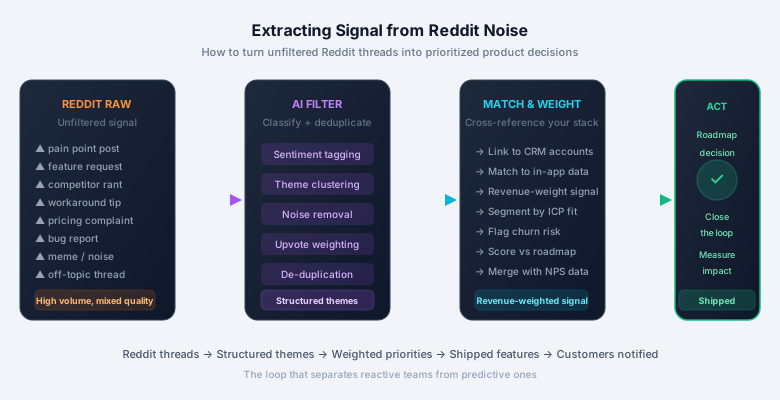
The key insight from pain-point analysis methodology: upvote count is a proxy for consensus. A post about a problem that gets 800 upvotes represents far broader agreement than a support ticket from a single user, even if the support ticket is more detailed. When you track upvoted Reddit discussions about your category, you're tapping into a continuously-updated demand signal that no survey can replicate.
Practical Reddit signal monitoring for product teams:
- Set up keyword alerts for your product name, top competitors, and the core problems your product solves.
- Weight by upvotes—ignore threads with under 50 upvotes as noise, focus on 200+ as signal.
- Track vocabulary shifts—when users start using new language to describe your category, your positioning may be drifting out of sync.
- Monitor competitor complaint threads—the frustrations users have with your competitors are your product's opportunity map.
The Feedback Dead Zone: Where Most Teams Live

The five truths above describe a common failure mode: teams trapped in what we call the feedback dead zone. They collect. They don't analyze. They don't act. They don't close the loop. Each failure compounds the next—without action, users stop submitting; without users submitting, the data gets worse; without data, decisions get made on intuition; bad decisions driven by intuition generate more complaints on Reddit.
Escaping the dead zone requires breaking the cycle at any point, but the highest-leverage intervention is almost always centralization + automation:
- Move all feedback channels into one system
- Use AI to eliminate manual analysis
- Connect feedback to revenue data to weight decisions correctly
- Automate loop-closing so users know they were heard
Teams that execute all four steps don't just have better product processes—they have a compounding advantage. Every satisfied feedback submitter becomes a more engaged future submitter. Every closed loop increases trust. Every revenue-weighted decision reduces wasted engineering. The advantage grows over time.
What the Best Teams Do Differently
The Reddit threads that stand out are the ones where a PM or founder describes the moment their feedback process clicked. The patterns are consistent:
- They stopped treating feedback as a list and started treating it as a system with owners, states, and SLAs.
- They connected feedback volume to business metrics—churn, expansion revenue, activation rates—so the value of acting on specific feedback was visible, not theoretical.
- They made feedback data accessible to engineering, not just product. Engineers who see the raw frustration behind a bug report fix it differently than engineers who see a ticket with no context.
- They measured feedback loop cycle time the same way they measured shipping velocity. The question wasn't just "how many features did we ship?" but "how long from user request to user notification?"
The Bottom Line
Reddit doesn't lie about product feedback. It describes, with brutal precision and public upvotes, the failures that most product teams are too polite to admit in internal reviews. The five truths above are not edge cases—they are the baseline experience of the majority of product teams in 2026.
The gap between the teams that fix these failures and the teams that don't is measured in growth rates, retention curves, and competitive distance. Feedback isn't a nice-to-have feature of good product management. It's the engine. And right now, most engines are broken.
The good news: every one of these failures has a known fix. The fixes aren't complex. They require commitment to building a system rather than hoping for a process. The teams that make that commitment stop appearing in Reddit's complaint threads—and start appearing in its success stories.
LoopJar is built around all five fixes: centralized collection, AI-powered analysis, revenue weighting, loop-closing automation, and Reddit signal monitoring in one platform. Start your free trial and stop showing up in someone else's Reddit thread.