Feedback Loops: Why Learning Velocity Beats Roadmap Volume
A practical look at customer feedback loops—what makes them tight, how they compound, and how to connect capture, synthesis, shipping, and follow-up without burning out your PM team.
Surya Pratap
Founder & CTO
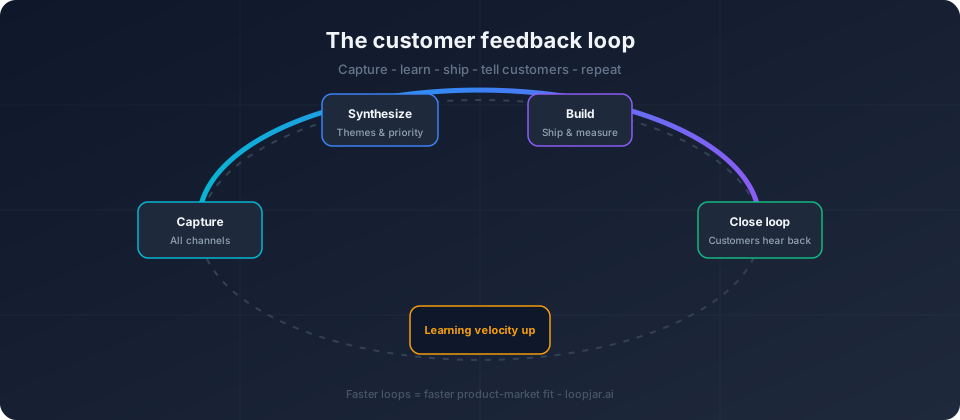
Every product team talks about "listening to customers." The ones that actually move faster share one trait: they run tight feedback loops—from signal to decision to shipped change to a customer who knows you heard them. Volume of roadmap items is vanity; learning velocity is the scoreboard.
What we mean by a feedback loop (and what we don't)
A feedback loop is not a quarterly survey and a slide deck. It is a repeating cycle: you capture input, turn it into decisions, ship, measure, and tell the people who gave input what happened. Skip the last step and you train customers to go quiet—exactly when you need signal most. Our earlier piece on closing the feedback loop walks through why that communication layer is non-negotiable for trust.
"Loop" also doesn't mean every request becomes a feature. It means every piece of signal gets a resolution path: shipped, planned, merged into a theme, or honestly deprioritized with rationale.
The four gears of a healthy loop
- Capture breadth. In-app, support, sales, community—without a single intake, you optimize locally and miss cross-channel themes.
- Synthesis speed. How fast raw text becomes themes, severity, and segment context. This is where teams drown without structure; it is also where AI-powered feedback analysis stops being a demo and becomes leverage.
- Decision clarity. Impact, confidence, and effort—aligned to strategy, not whoever complained loudest last week.
- Closed-loop communication. Status changes, release notes, and "we heard you" moments that tie back to the original submitter when possible.
If you want the full stack view of how AI changes each stage, read Building a modern product feedback loop — and how AI makes it 10× better—it complements this article by going deep on automation and scale.
Why loop length is your real bottleneck
Long loops hide problems. When synthesis takes three weeks, you ship fixes for January's complaints in April. Customers experience that as indifference—even if your team worked hard. Shortening the loop is less about working harder and more about removing handoffs: one queue, one taxonomy, one place PMs review.
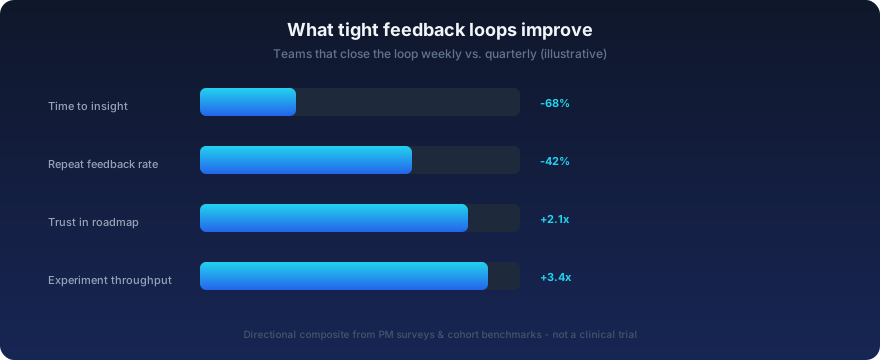
The chart above is directional: the point is relative improvement when you move from "quarterly synthesis" to "weekly closed-loop rituals." The exact numbers will vary by segment—but the ordering rarely does.
How revenue and public signal plug in
Feedback loops are not only a product discipline; they are a revenue lens when you connect themes to packaging and willingness to pay. Our playbook on feedback-driven revenue ideation shows how to treat Reddit, X, and internal signals as one funnel for bets—not just feature votes.
Automation without losing the human story
As volume grows, autonomous feedback pipelines help you classify and summarize in minutes. The failure mode is over-automation: summaries with no link back to the customer sentence that mattered. Balance automation with the habits we surfaced in what product teams learned about AI-powered feedback in 2026—keep humans on prioritization and relationship, let machines handle throughput.
A simple cadence you can steal
- Monday: Theme review from the unified queue (not five tools).
- Wednesday: Decision memo—what ships this cycle, what merges into a larger bet, what you are not doing and why.
- Friday: Customer-visible updates—changelog, email, or board replies that close the loop.
If you are evaluating how LoopJar fits your stack, see pricing and the product tour on the homepage—the goal is one loop, not another siloed dashboard.
Related reading on the LoopJar blog
- Closing the feedback loop: why customer communication matters
- Building a modern product feedback loop — and how AI makes it 10× better
- AI-powered feedback analysis: from chaos to clarity
- Feedback-driven revenue ideation (Reddit & X playbook)
- AI agents for customer feedback and autonomous pipelines
Ship less for the sake of shipping; learn faster on purpose. The best roadmap is the one your customers can see themselves in—because the loop never went dark.