
How LinkedIn Builds Powerful Feedback Systems: Lessons Every Product Team Needs
LinkedIn's real-time developer feedback system, 240% messaging engagement jump, and full-stack builder model reveal a blueprint for feedback-driven product development. Here's what your team can steal.
Priya Sharma
Head of Product Intelligence
LinkedIn has 1 billion members and ships product changes that affect how professionals across every industry communicate, hire, and learn. Getting feedback right at that scale isn't optional—it's existential. So when LinkedIn's engineering and product teams redesigned their approach to collecting and acting on feedback, the rest of the industry took notice.
What emerged is a blueprint that any product team—from two-person startups to Fortune 500 organizations—can learn from. In this article, we dissect how LinkedIn builds powerful feedback systems, why their approach produces measurably better outcomes, and the specific practices you can adapt immediately.
The Problem LinkedIn Solved First: Real-Time Feedback at Scale
LinkedIn's Developer Engagement and Insights team identified a fundamental flaw in traditional feedback collection: the gap between experience and measurement. Surveys sent days after a deployment don't capture the emotional moment of friction. Retrospectives held weeks later rely on reconstructed memories.
The breakthrough insight, attributed to Jared Green, LinkedIn's VP of Developer Productivity and Happiness, was simple but powerful: "Let's just ask developers right after the thing happened."
This idea—capturing feedback at the exact moment of experience—became the foundation of LinkedIn's real-time feedback system. The results were transformative. By intercepting users at the point of action rather than surveying them in the abstract, LinkedIn collected feedback that was:
- Contextually precise — Users described specific friction, not vague impressions.
- Emotionally accurate — Sentiment matched the actual experience, not a faded memory.
- Actionable immediately — Engineers could correlate feedback spikes to specific deployments in real time.
The 240% Signal: What Happens When Feedback Drives Design
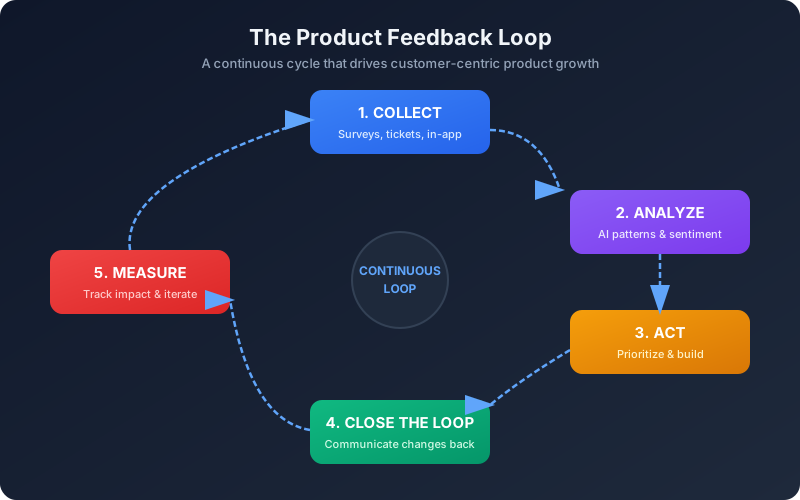
LinkedIn's messaging redesign is now one of the most cited examples in product management circles. When the team committed to a tight user-feedback cycle—collecting input, analyzing it rapidly, and iterating before the next sprint—they didn't just improve a feature. They achieved a 240% increase in messages sent.
That is not a marginal improvement. It is a fundamental shift in user behavior driven entirely by listening systematically. The messaging redesign was followed by LinkedIn's largest desktop overhaul since the platform's founding—described internally as "the largest redesign since LinkedIn's inception"—which was similarly driven by continuous feedback analysis rather than executive intuition.
The pattern LinkedIn demonstrated:
- Collect at scale — Use in-product widgets, behavioral signals, and direct surveys triggered by specific interactions.
- Analyze continuously — Don't wait for monthly reports. Use AI to cluster themes as feedback arrives.
- Act with speed — Reduce the time from insight to implementation to days, not quarters.
- Close the loop visibly — Communicate changes back to users who provided feedback.
The Full-Stack Builder Model: Feedback Ownership at Every Level
Under Chief Product Officer Tomer Cohen, LinkedIn restructured its product organization around a principle that has profound implications for feedback systems: the full-stack builder model.
Instead of large functional teams where a PM writes specs, hands off to design, who hands off to engineering, LinkedIn moved toward small cross-trained "pods" where individuals can take a product from idea to launch themselves. This structural shift changed everything about how feedback flows through the organization.
In a siloed organization, feedback gets filtered, translated, and diluted as it moves between functions. In a full-stack model, the person who collects the feedback is often the person who fixes the problem. The result:
- Feedback cycles shrink from weeks to days.
- Context loss between collection and implementation is eliminated.
- Customer empathy becomes a core engineering competency, not a PM responsibility.
LinkedIn's Data on Teams That Use Feedback Systems
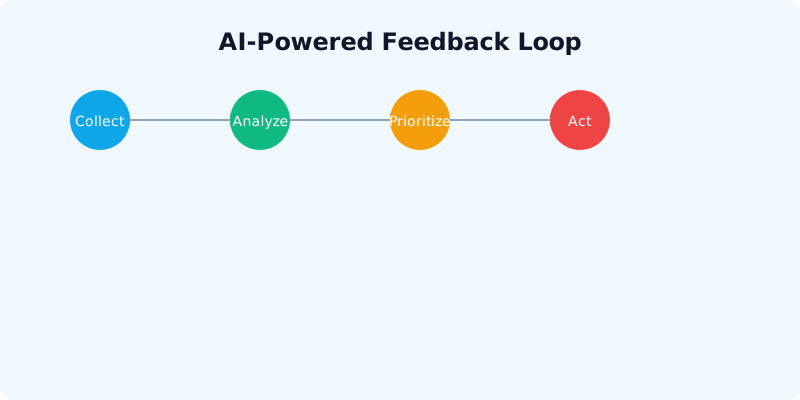
LinkedIn's research and platform data across its 1 billion-member network provides one of the most comprehensive views of product team performance available anywhere. The numbers make an unambiguous case for systematic feedback loops.

60% Higher Profits
Companies prioritizing customer feedback loops consistently outperform peers on profitability. LinkedIn's own platform data shows that companies in its ecosystem that invest in feedback infrastructure see higher engagement, longer retention, and faster upsell rates—all leading indicators of profit growth.
Feedback Fluency Is Now a Top-10 Hiring Skill
LinkedIn's 2026 "Skills on the Rise" report found that cross-functional collaboration, data storytelling, and customer empathy—the three skills at the core of effective feedback loops—are among the fastest-growing competencies that recruiters prioritize. Nearly half of all recruiters now use skills-based data to fill product roles, and feedback management experience is increasingly listed as a differentiator.
Teams With Feedback Systems Make Decisions 40% Faster
Research aggregated from LinkedIn's product management community found that teams with organized, AI-assisted feedback systems make product decisions 40% faster than teams relying on spreadsheets and tribal knowledge. Speed matters because the cost of a slow decision compounds: delayed features cede ground to competitors, delayed fixes churn customers, delayed roadmap adjustments waste engineering cycles.
The Four Maturity Levels: Where Is Your Team?
Based on patterns observed across LinkedIn's ecosystem of product teams, feedback systems fall into four maturity levels. Most teams significantly overestimate where they sit.

Level 1 — Reactive Collection
Feedback arrives through support tickets and informal channels. There's no system. PMs hear about problems through escalations. NPS is measured quarterly and discussed in a meeting no one acts on.
Level 2 — Organized Collection
A tool exists (Canny, Productboard, Intercom) and feedback is stored. But analysis is manual, categorization is inconsistent, and the loop is rarely closed. Teams know what customers are saying but don't have a reliable process for acting on it.
Level 3 — Systematic Analysis
AI-powered categorization eliminates manual tagging. Feedback is weighted by customer revenue and segment. Product decisions are explicitly linked to feedback data. The loop is closed regularly. This is where LinkedIn-caliber teams operate.
Level 4 — Predictive Intelligence
Feedback sentiment predicts churn before it happens. Revenue-at-risk is calculated automatically from feedback trends. Roadmap decisions are made with quantified confidence, not just directional guesses. Automated communications close the loop at scale without manual effort.
The uncomfortable data point: 73% of product teams are still at Level 1 or Level 2. The gap between Level 2 and Level 3 is where the competitive race is won or lost.
How LinkedIn Targets the Right Users for Feedback
One of the most underappreciated elements of LinkedIn's feedback system design is user targeting. Asking the wrong users for feedback produces noise. Asking too many users at once produces survey fatigue. LinkedIn's approach:
- Trigger based on actual usage patterns — Only users who have meaningfully engaged with a feature receive feedback prompts about that feature.
- Respect feedback frequency limits — No user is prompted more than once per defined period, preventing fatigue and maintaining response quality.
- Apply learnings across channels — Insights from real-time prompts are applied to improve periodic survey design, creating a compounding understanding of user segments.
This targeting discipline separates LinkedIn's data quality from the noisy surveys that most teams run. When your feedback population is biased toward disengaged users or users who haven't actually used the feature being asked about, every insight is corrupted from the start.
The Vendor Intelligence Layer: Feedback as Competitive Data
LinkedIn extends its feedback systems beyond product users to an unexpected audience: vendors and tooling providers. LinkedIn collects feedback from external tool ecosystems to generate comparative satisfaction data—giving executives a clear view of which internal systems create the most friction and which vendors are outperforming their alternatives.
This practice has three compounding benefits:
- It surfaces tooling pain points that would otherwise be invisible to leadership.
- It creates competitive pressure on vendors to improve, without requiring contract renegotiations.
- It builds an evidence base for technology investment decisions that is grounded in user experience data, not sales presentations.
The lesson for product teams: feedback systems shouldn't be limited to end-user product feedback. Internal tooling, vendor performance, and cross-functional process friction are all valid feedback domains with high ROI for systematic collection.
What Your Team Should Implement This Quarter
LinkedIn's feedback system didn't emerge fully-formed. It was built iteratively, with each capability unlocking the next. Here's a practical sequence for teams at each maturity level:
If You're at Level 1: Centralize First
Pick one tool and route all feedback into it. Support tickets, NPS responses, sales call notes, social mentions—everything in one place. Don't worry about AI or automation yet. Just eliminate the silos. You cannot analyze what you cannot find.
If You're at Level 2: Automate the Analysis Layer
Manual tagging doesn't scale and introduces human bias. Implement AI-powered categorization so themes emerge from the data rather than being imposed on it. This single step saves most teams hundreds of hours per month and surfaces patterns that manual review misses entirely.
If You're at Level 3: Implement Revenue Weighting
Integrate your feedback tool with your CRM and billing data. A churn signal from a $200k ARR enterprise account is categorically different from the same complaint from a free-tier user. Revenue-weighted prioritization is the mechanism that turns feedback into defensible roadmap decisions.
If You're at Level 4: Close the Loop at Scale
Automate the "you asked, we built" communication. When a feature ships that was requested by identifiable users, tell them automatically. Forrester's data shows this increases future feedback participation by up to 3×—compounding the quality and volume of your insight stream over time.
The Bottom Line
LinkedIn's approach to feedback systems isn't a secret. It's documented in their engineering blog, discussed openly by their product leaders, and visible in the measurable outcomes they've shared publicly: a 240% messaging engagement increase, the largest desktop redesign in their history, and a platform that serves a billion members without losing the responsiveness of a startup.
The components are replicable. Real-time collection at the moment of experience. AI-powered analysis that surfaces themes without manual effort. Targeting discipline that maintains data quality. Revenue weighting that connects feedback to business outcomes. Loop-closing that compounds participation over time.
The question isn't whether these practices work. LinkedIn's data makes that clear. The question is how quickly your team can move from knowing about them to actually running them.
LoopJar brings all five components of LinkedIn-caliber feedback systems into a single platform—built for teams who want to stop guessing and start building with confidence. Start your free trial today.