
Product Pipeline Pain Points in 2026: Where Work Stalls and How AI Fixes the Friction
Research-backed look at intake, triage, prioritization, build, and learning—why modern product pipelines break under volume, and how AI classification, clustering, and loop-closing fit into a disciplined human workflow.
Surya Pratap
Founder & CTO
The product pipeline is not a linear factory line. It is a loop: ideas and signals enter, get interpreted, turn into bets, ship, and feed learning back. When any stage is starved of context or time, the whole system feels slow—even if engineering execution is strong. Recent industry research on product management automation and AI adoption (2024–2026) consistently finds the same tension: teams want speed and consistency without giving up strategic judgment. This article maps the recurring pain points and where AI actually helps—without pretending software can replace ownership.
What we mean by the pipeline
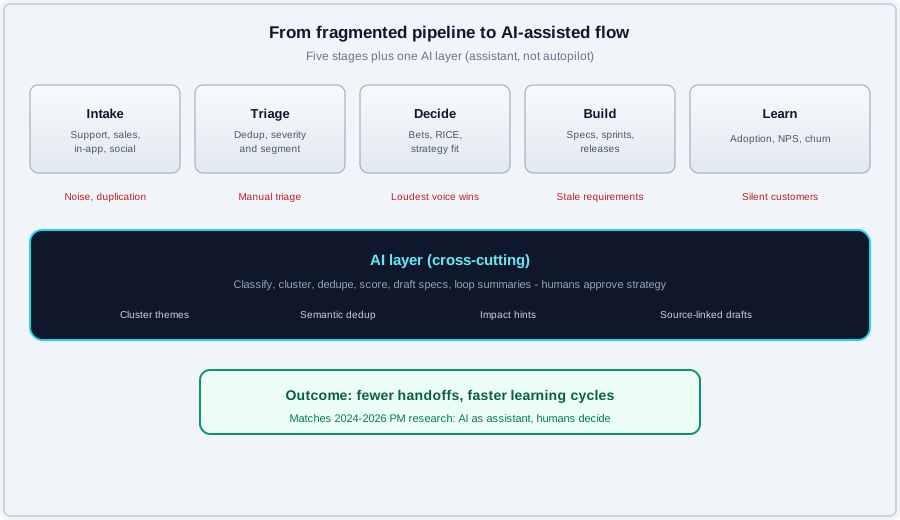
For this piece, the pipeline spans five practical stages: intake (everything customers and GTM say), triage (what it is, how severe, who it affects), decide (what we bet on next), build (specs, delivery, release), and learn (adoption, quality, churn, follow-up). Surveys of product professionals over the last two years show near-universal experimentation with AI assistants for writing, research, and backlog hygiene—but also recurring complaints: weak product context, shallow ties to live customer data, and over-trust in generic summaries. The fix is not “more AI,” it is AI wired into the same systems your team already defends in roadmap reviews.
Pain point 1: Fragmented intake (signal everywhere, truth nowhere)
Symptoms: Support tags one way, sales logs another, Slack threads disagree with the public board, and app reviews add a fourth vocabulary. PMs become human routers—copying between tools instead of deciding.
Why it hurts: Duplicated tickets and conflicting labels inflate volume, hide true severity, and make segment analysis (enterprise vs. self-serve) a spreadsheet project.
How AI helps: Modern models are strong at semantic clustering and near-duplicate detection across text sources, plus coarse intent labels (bug vs. request vs. pricing) when trained or prompted with your taxonomy. The goal is a single queue of themes, not perfect prose. For a deeper take on turning chaos into structure, see AI-powered feedback analysis and our guide on how AI cuts feedback analysis time.
Pain point 2: Triage latency (the backlog grows faster than review bandwidth)
Symptoms: Weekly triage meetings skim the surface; items age; customers hear “we’re looking into it” for months. Research on automation in product work repeatedly cites context switching and repetitive classification as top drags—exactly the work humans are worst at scaling.
Why it hurts: Stale triage is indistinguishable from indifference. Churn and expansion conversations happen while the underlying issue was already in the backlog.
How AI helps: Automated first-pass triage—routing, deduplication, suggested severity, and “same theme as X” linking—cuts queue time so PMs review exceptions and strategic calls, not every sentence. Autonomous pipelines (with guardrails) are covered in AI agents for customer feedback. For workflow automation patterns, n8n workflows for product feedback is a useful complement.
Pain point 3: Prioritization politics (loudest voice wins)
Symptoms: Roadmaps react to the last executive ping or the biggest logo, while small accounts with clear product-market pull get starved. Frameworks like RICE exist on slides but not in the data layer.
Why it hurts: Without explicit, comparable signals (impact, confidence, reach, segment value), prioritization becomes a negotiation—not a bet.
How AI helps: Models do not replace strategy; they surface patterns you can argue with: recurring themes weighted by frequency, revenue-adjacent language, churn risk phrases, and post-release sentiment shifts. Pair that with honest business rules (e.g., enterprise blockers first). For tying public demand signals to revenue language, read feedback-driven revenue ideation.
Pain point 4: GTM–engineering disconnect (two stories about “what matters”)
Symptoms: Sales promises drift from the roadmap; support promises a fix date that engineering has not scoped; marketing announces a feature that only half-exists.
Why it hurts: The pipeline is not slow because of Jira—it is slow because shared truth about customer pain is missing.
How AI helps: Summaries that link back to source quotes (ticket, call snippet, review) reduce “telephone game” distortion. That is also where trust breaks if AI hallucinates—see the AI trust gap in product feedback. The durable pattern: AI drafts, humans validate against source.
Pain point 5: Weak learning loops (ship, then silence)
Symptoms: Releases go out without targeted follow-up; customers who gave input never hear outcomes; the next quarter’s roadmap ignores last quarter’s learning.
Why it hurts: Without closure, feedback quality drops—you train customers that speaking up does not matter.
How AI helps: Personalized or segmented updates, “you asked, we shipped” summaries, and changelog alignment to themes are all high-leverage generation tasks once themes are known. The strategic frame is in feedback loops and learning velocity and closing the feedback loop. For the full stack story, building a modern product feedback loop with AI ties the pieces together.
What research agrees on (and what it warns about)
Analysts and vendor-neutral write-ups in 2024–2026 converge on a few points: product teams do save meaningful time when AI handles repetitive drafting and organization; quality drops when models lack product-specific context; and human review remains mandatory for prioritization, risk, and ethics. The winning pattern is not “AI owns the roadmap”—it is AI compresses cycle time so humans spend minutes on judgment instead of hours on clerical work.
How to adopt without breaking trust
- One intake surface. Connect channels before you tune models.
- Shared taxonomy. Align tags with how you actually talk about roadmap bets.
- Source-linked outputs. Every AI summary should point to raw evidence.
- Weekly human review. Override bad clusters fast—models learn from corrections.
- Explicit “not doing” decisions. Transparency beats silent backlog decay.
Where LoopJar fits
LoopJar is built around this exact loop: unify feedback, apply AI for classification and themes, and keep humans in control of what ships. Explore features, pricing, and how we compare as a Canny alternative. For company context, see about LoopJar.
Related reading
- AI agents for customer feedback: autonomous pipelines
- Feedback loops: learning velocity vs. roadmap volume
- AI-powered feedback analysis
- Building a modern product feedback loop with AI
- How AI reduces feedback analysis time
AI in the product pipeline is best understood as compression: less time sorting, more time deciding. The pipeline does not get “automated away”—it gets honest again.