
The X (Twitter) Product Feedback Playbook: How to Turn Real-Time Signals into Roadmap Gold
80% of social media customer service requests happen on X. Yet most product teams treat Twitter as a marketing channel, not a feedback engine. Here's the complete playbook for changing that.
Marcus Webb
Head of Growth & Product
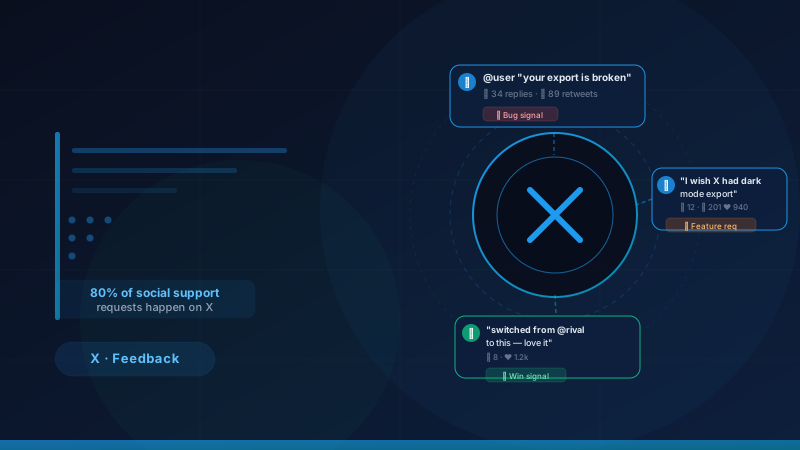
Every day, millions of people tell the internet exactly what they think about your product—on X (Twitter). They describe bugs with specificity that would impress your QA team. They articulate feature gaps in language that would rewrite your positioning. They announce their churn reasons publicly, before they even email support.
And most product teams are not listening.
According to Zendesk, 80% of customer service requests on social media happen on X. Yet the majority of product organizations treat Twitter as a broadcast channel for announcements, not an intelligence channel for product decisions. That gap—between what users are saying and what teams are hearing—is one of the most underexploited advantages in product development today.
This is the playbook for closing it.
Why X Is Different From Every Other Feedback Channel
Before the tactics, understand what makes X structurally unique as a feedback source. It is not a survey, a support ticket, or an NPS response. It is a public, permanent, emotionally-unfiltered record of how real people experience your product in real time.
That distinction has four compounding implications:
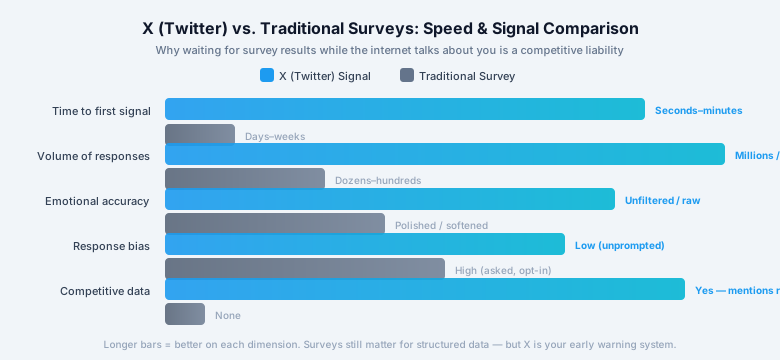
- No prompting: Users are not responding to your question. They are describing what they actually feel, unprompted, to their network. This eliminates response bias entirely.
- Retweet amplification: A frustration that resonates with 10 people becomes visible to 10,000 within hours. Volume on X is a proxy for breadth of the problem, not just depth of one user's experience.
- Competitive transparency: Users tag competitors, complain about alternatives, and announce switches publicly. Your rivals' weaknesses are searchable in real time.
- Timing precision: Unlike a quarterly NPS survey, X feedback arrives the moment the experience happens—during onboarding, immediately after a failed export, seconds after a price increase email lands in their inbox.
The 6 Signal Types in Your X Feed
Not all tweets are created equal. Product teams that use X effectively learn to recognize and triage six distinct signal types, each with different urgency and different action paths.

1. Bug Reports (Urgency: Critical)
A cluster of tweets mentioning your product name alongside "broken," "not working," "error," or specific feature names is a real-time incident report. The moment this pattern emerges, engineering should be aware. These threads move fast—a bug that affects 100 users becomes a 1,000-retweet thread within a day. By the time it reaches your support queue, it has already become a reputation event.
Action trigger: Any tweet mentioning your product name + "broken / error / not working" should auto-alert your on-call team, the same way a Datadog alert fires on anomalous error rates.
2. Feature Requests (Urgency: High)
"I wish [product] could…" is the most undervalued phrase in product development. It appears constantly on X, from users who are engaged enough to want more from your product but haven't found a formal feedback channel. These are not complaints—they are desire signals from your most invested users.
A single high-engagement tweet requesting a feature (100+ likes, 20+ retweets) indicates market-level demand, not just individual preference. Track these and deduplicate them against your existing roadmap.
3. Competitor Complaints (Urgency: High)
When users vent publicly about your competitors, they are sending two signals simultaneously: a pain point exists in the market, and they are open to switching. Sprout Social data shows that monitoring competitor mentions on X is one of the highest-ROI activities for acquisition-focused product teams.
The approach: set up keyword monitoring for competitor brand names + "frustrating / cancelling / switching / alternative." These threads are your acquisition map. The users complaining are pre-qualified—they're already in your category, already experiencing the pain you solve, and already broadcasting their openness to change.
4. Churn Signals (Urgency: Critical)
"Just cancelled my [product] subscription" is a public exit interview. And unlike a cancellation survey (which captures only what users are willing to say in your product's own interface), the X version is unfiltered. Users describe the actual breaking point—the specific interaction that finally pushed them to leave.
Research from Sprout Social found that 34% of X users who had a positive service experience went on to purchase or recommend the product. The inverse is equally true: negative experiences shared publicly accelerate churn across the wider audience who sees the thread.
5. Praise & Win Signals (Urgency: Medium)
"Switched from [competitor] to [your product] and never looked back" is more than a nice notification. It tells you what your product actually does better than alternatives—in the user's own words. This language is gold for positioning, copywriting, and sales enablement. The phrases users use publicly to describe your value are often more accurate than the phrases your marketing team invented in a positioning workshop.
6. Pricing Friction (Urgency: High)
Pricing complaints on X have a specific pattern: users don't just complain that something is expensive; they articulate the value mismatch. "Too expensive for what you get" tells you the perception problem. "Cheaper than competitors but hides features behind add-ons" tells you the packaging problem. Monitor these threads during every pricing change—they are the fastest early warning system for a positioning mistake.
Building the X Feedback Stack: Step by Step
The gap between knowing X contains valuable signals and actually capturing them is a workflow problem. Here is the operational stack that separates teams that use X effectively from those that scroll their mentions once a week.

Step 1: Define Your Keyword Universe
Start with four keyword buckets:
- Brand bucket: Your product name, company name, common misspellings, @handle mentions
- Problem bucket: The specific pain points your product solves, described in user language (not marketing language)
- Competitor bucket: Names of your top 3–5 competitors plus the category terms users apply to all of you
- Intent bucket: "looking for alternative to," "switching from," "cancelled [category]," "recommendation for [category]"
Step 2: Set Up Tiered Alerting
Not all X signals need the same response time:
- Immediate (real-time): Bug reports, outage mentions, public complaints with 50+ engagements — alert on-call/support within minutes
- Same-day: Feature requests, churn signals, competitor complaints — route to PM queue
- Weekly digest: Praise, pricing feedback, general sentiment — review in product review
Step 3: Route Signals to the Right Owner
The signal is worthless if it sits in a monitoring dashboard that nobody acts on. Map each signal type to a named owner:
- Bug reports → Engineering lead / on-call
- Feature requests → Product manager
- Churn signals → Customer success + PM
- Competitor complaints → Growth + PM
- Pricing friction → Product + Revenue
Step 4: Deduplicate Against Your Feedback System
X signals should flow into the same system as your in-app feedback, NPS data, and support tickets. When a feature request appears on X, you need to know immediately if it has also appeared in 30 support tickets. That combined signal—X public demand + private support volume—is your prioritization case.
Step 5: Close the Loop Publicly
When you ship something that users requested publicly on X, respond to the original thread. This is not just good community management—it is a product marketing event. A reply that says "You asked for this in March. It's live today." turns one satisfied user into a visible testimonial that their followers see.
Forrester's research shows that closing the feedback loop increases future feedback participation by up to 3×. On X, that multiplication effect happens publicly—every closed loop builds your reputation as a team that actually listens.
The Velocity Advantage: X vs. Traditional Feedback
The most underappreciated advantage of X as a feedback channel is timing. Consider the lifecycle of a product problem through different feedback channels:
- X (Twitter): User experiences problem → tweets about it → you see it within minutes → you respond or escalate within the hour
- Support ticket: User experiences problem → opens a ticket → it enters a queue → it gets triaged → PM reviews weekly
- NPS survey: User experiences problem → quarterly survey triggers → user may or may not mention it → PM reviews monthly digest
By the time the support ticket reaches a PM, the X thread has already been retweeted 500 times and a competing product has already replied to the user's original complaint offering a free trial.
Speed of signal is a competitive advantage when your team is equipped to act on it.
What X Won't Tell You (And What Fills the Gap)
X is powerful, but it has real blind spots that product teams must account for:
- Silent majority: Users who churn without tweeting about it represent the majority of churn. X captures only the vocal minority.
- Demographic skew: X users skew toward tech-savvy, English-speaking, higher-income demographics. If your users are outside this demographic, X signals are systematically biased.
- No revenue attribution: A tweet from a $200k ARR enterprise client and a tweet from a free-tier user look identical on X. Without CRM integration, you cannot weight X signals by business value.
- Context collapse: Tweets strip context. "This feature is terrible" could mean many things—without a way to follow up, you're guessing at the underlying problem.
The fix for all four blind spots is the same: X signals must be integrated with your broader feedback stack, not operated as a standalone channel. X is your early-warning radar. Your in-app feedback system, NPS data, and CRM are your targeting systems. Together they work. Separately, each has significant gaps.
The X Feedback Maturity Model
Where does your team sit today?
- Level 0 — Not monitoring: Nobody is watching your product mentions on X. Problems escalate to PR crises before engineering knows about them.
- Level 1 — Manual monitoring: Someone checks mentions once a day. Bugs are caught slowly. Feature signals are not systematically captured or routed.
- Level 2 — Alerting setup: Keyword monitoring fires alerts. Bug reports reach engineering fast. But signal classification and routing is still manual.
- Level 3 — Integrated pipeline: X signals are automatically classified by type, routed to owners, deduplicated against your feedback system, and weighted by engagement and business context.
- Level 4 — Predictive intelligence: Sentiment trends on X predict feature adoption and churn. Launch decisions incorporate X signal forecasting. Closed loops are automated and measured by downstream retention impact.
The majority of product teams are at Level 0 or Level 1. The competitive distance between Level 1 and Level 3 is measured in the speed of your response to market signals—and speed of response to market signals is increasingly the primary competitive differentiator in software.
The Bottom Line
X is not a marketing channel that happens to contain some customer complaints. It is a real-time, public, emotionally-unfiltered product feedback stream that most teams are leaving entirely untapped.
The 80% statistic from Zendesk is not an argument for investing in X customer service. It is an argument for building a product intelligence system that treats every public mention of your product as a data point in your feedback loop—classified, routed, weighted, acted on, and closed.
The teams that do this stop being surprised by churn. They stop shipping features that solve the wrong problems. They start shipping what users are publicly asking for, and closing the loop in the same public space where the request was made.
That is not a nice-to-have. In 2026, it is the baseline expectation.
LoopJar centralizes X signals alongside in-app feedback, NPS, and support data—automatically classifying, routing, and weighting every signal so your team always knows what to build next. Start your free trial today.