
LinkedIn and X on Feedback Loops: What Professional Signal and Public Velocity Teach Product Teams
We compared how feedback loops show up in LinkedIn’s engineering practice versus how builders describe learning from X (Twitter). Here is a practical playbook for combining slow, contextual depth with fast, public pressure—without letting either source hijack your roadmap.
Surya Pratap
Founder & CTO
If you only read one kind of internet, you get a distorted picture of your product. LinkedIn rewards long-form, career-safe narratives about systems and maturity; X rewards hot takes, screenshots, and threads that move in hours. Both are real markets for ideas—and both shape how teams think about feedback loops. The job is not to pick a favorite platform, but to design a loop that uses each channel for what it is good at.
Why we looked at LinkedIn and X side by side
Product feedback is no longer a single inbox. It arrives through support, sales notes, in-app widgets, Slack, reviews, Reddit, LinkedIn comments on launch posts, and quote-tweets when something breaks. The question is not “where should we listen?” but how we weight and reconcile different textures of signal.
This article pulls two public lenses into one framework:
- LinkedIn — especially engineering and operator content that emphasizes context, participation design, and closing the loop with rationale.
- X (Twitter) — the pattern of unprompted, high-velocity, and reputation-amplified feedback that product and founder discourse treats as a live pulse on launches, pricing, and reliability.
We tie LinkedIn’s published developer-experience work to first principles, then map how X-style signal should plug into the same loop without mistaking loud for representative.
LinkedIn: feedback loops as an engineering discipline
LinkedIn’s Developer Experience and Productivity team has written in detail about moving from quarterly surveys to real-time, contextual feedback for internal developer tooling. Their public write-up is unusually concrete about why periodic surveys break down: respondents rating tools they had not touched in months, comments with almost no situational context, and ratings that could refer to either the “before” or “after” of a release shipped between survey waves.
The alternative they describe is a system that observes actions across UIs, CLIs, and internal APIs, then decides if, when, and how to ask for input—often at the end of a flow (for example, after a deployment), with throttling so people are not spammed. Participation roughly doubled versus their old periodic surveys (they report moving from roughly 15% of the population to over 30%). That is not vanity engagement; it is a wider slice of reality entering the loop.
Three lessons from that narrative map cleanly to customer-facing products:
- Memory is a bug, not a feature. Feedback collected long after the moment drifts toward generic opinion. In-product prompts tied to completed intents preserve what happened and which job the user was trying to finish.
- Context is the difference between noise and work orders. “Sometimes it feels slow” is not actionable; “export froze after the 10k-row mark on Chrome” is. The LinkedIn approach treats context capture as infrastructure, not a nice-to-have field on a form.
- Closing the loop sustains the loop. They describe synthesizing feedback into reports, driving action, and when teams choose not to act, sharing the reasoning back to the person who submitted input. That is the cultural half of the system—without it, participation collapses.
They summarize that operating model as Listen, Act, and Share—which is the same spine we advocate for customer-facing loops in pieces like closing the feedback loop and learning velocity over roadmap volume.
Primary source: LinkedIn Engineering, “How LinkedIn turned to real-time feedback for developer tooling” (Developer Experience / Productivity blog).
X (Twitter): feedback loops as market weather
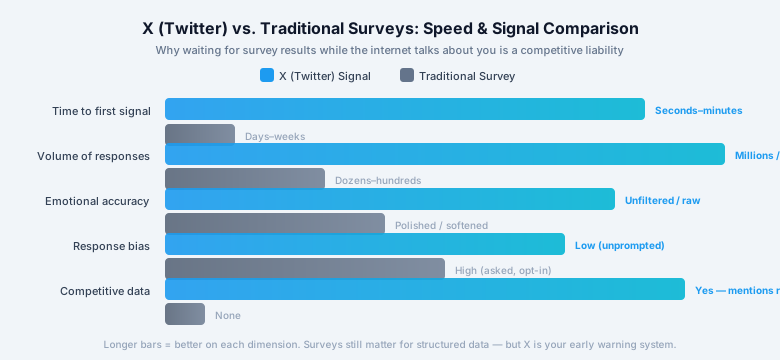
X does not give you a methodology post with participation percentages. What it gives you is speed and social proof. In public builder threads and launch-day discussions—documented extensively in playbooks like our X product feedback playbook—a few patterns repeat:
- Unprompted language. People describe pain in their own words, often with screenshots and repro steps, because they are venting or helping peers—not because they answered your survey.
- Compression of time. A regression can become a visible cluster of posts in a morning; a pricing change becomes a natural experiment in willingness-to-pay expressed as jokes, anger, and alternatives named out loud.
- Reputation externalities. Prospective buyers read threads the same way they read reviews. That means X is both a sensor and a distribution channel; ignoring it does not neutralize it.
The failure mode is just as obvious: volume is not representativeness. A viral thread might reflect a narrow segment, a competitor-led pile-on, or an edge case that feels universal because it is loud. Treat X as a high-bandwidth hypothesis generator, then validate with product analytics, CRM segments, and support volume—exactly the cross-check we outline when connecting social signal to revenue bets in feedback-driven revenue ideation.
Where the two worlds agree
Despite opposite vibes—polished professional narrative versus chaotic real-time stream—serious operators on both sides converge on a handful of principles:
- Context beats charisma. LinkedIn’s engineering story is essentially an argument for situational data. X posts that actually help teams ship include repro details, versions, and timestamps—the same thing, just crowdsourced.
- Throttle and respect opt-out. LinkedIn explicitly caps solicitations and honors channel preferences. On X, the analog is brand behavior: reply thoughtfully, do not dogpile customers who complain, and do not treat every subtweet as a P0.
- Explain non-action. When you decline a path, silence trains people to stop reporting. LinkedIn’s internal loop calls out sharing rationale; externally, a crisp “not now because…” in release notes or a board status update preserves trust.
- Synthesis is the bottleneck. Collecting more feedback is easy; turning it into stable themes with segment labels is hard. That is why teams adopt unified queues and AI-assisted clustering, as in AI-powered feedback analysis, instead of letting each channel live in its own tab forever.
Where they pull in different directions (and how to balance)
| Tension | LinkedIn-heavy bias | X-heavy bias | Balanced move |
|---|---|---|---|
| Tempo | Mature narratives; slower proof | Minutes-to-hours heat | Use X for detection; use your queue for triage SLAs |
| Representativeness | Selection toward people who post on LinkedIn | Outliers can dominate reach | Tag themes with segment and ARR, not just engagement |
| Incentive | Career-safe, sometimes abstract | Performative outrage risk | Reward specific reports privately; fix in public |
(Table is a heuristic for planning conversations, not a scientific sample of either network.)
A dual-signal operating cadence you can run this quarter
- Instrument the moment. Ship in-context prompts on the top three flows where churn or expansion actually happens—borrow the LinkedIn lesson that timing and intent beat recall.
- Mirror public fire into private structure. When X spikes on a topic, create a single ticket or theme, link representative posts as evidence, and decide owner + SLA. Your LinkedIn-style systems thinking should meet your X detection playbook in one board.
- Publish the decision. Weekly or biweekly, ship customer-visible notes: shipped, planned, merged into a larger bet, or not now—with why. That is Listen–Act–Share adapted for external users.
- Measure loop health, not vanity counts. Track time-to-first-response, time-to-resolution, repeat rate on the same theme, and leading retention on accounts whose feedback was acknowledged—even when you did not build their exact request.

Closing thought
LinkedIn’s public engineering narrative and the X feed are not opposites; they are two sampling strategies over the same underlying reality—people trying to get jobs done with your product. Use LinkedIn-class discipline to respect context, participation, and follow-up. Use X-class vigilance to catch what your survey would miss. The loop is tight when both kinds of signal collapse into one honest decision trail your team can defend—and your customers can see.
Sources and further reading
- LinkedIn Engineering — How LinkedIn turned to real-time feedback for developer tooling
- LinkedIn — LinkedIn’s AI stack and agent directions (useful context on human-in-the-loop and scaled systems that depend on feedback)
- LoopJar — The X (Twitter) product feedback playbook
- LoopJar — How LinkedIn builds powerful feedback systems
Platforms change; the loop equation does not: capture in context, decide in daylight, ship, explain, repeat. Speed without follow-up is theater; process without public awareness is blindness.